#15 – The Bitch of It Is You Probably Did the Right Thing (ENDGAME, RISING STAR)
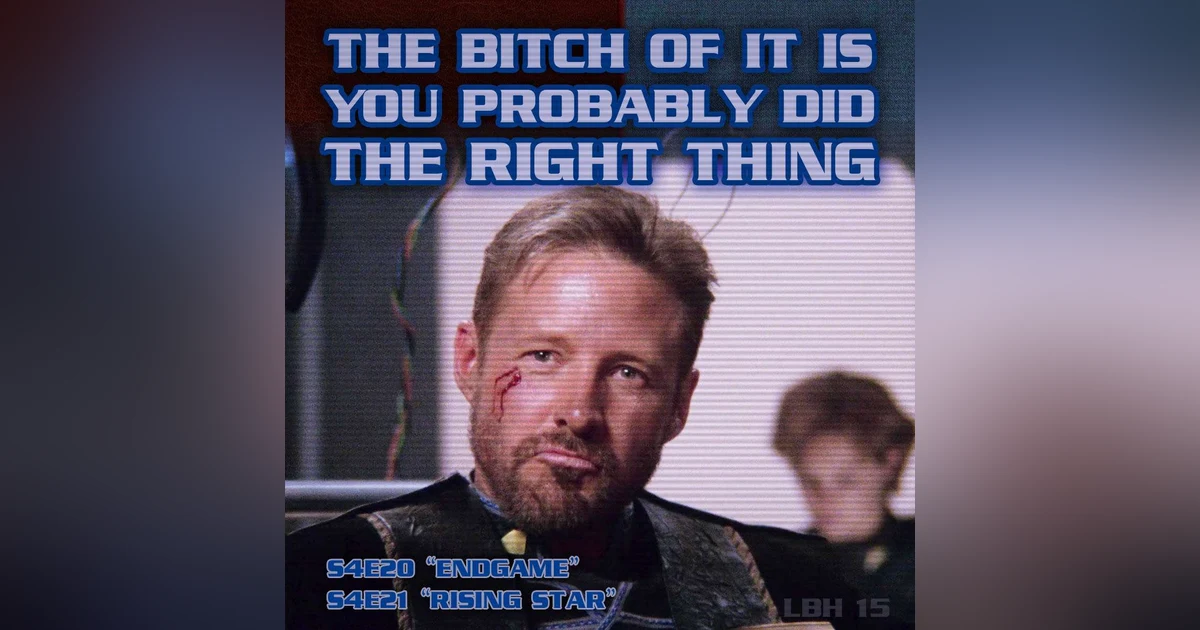
The Earth Civil War is over, but the harder question is what comes next. Josh and John revisit season 4's "Endgame" and "Rising Star" to talk about how democracies recover from authoritarianism, why good people obey bad leaders, what makes Sheridan such an extraordinary leader, and why Babylon 5's vision of power, media, and moral courage feels uncomfortably relevant.
This is a jam-packed episode folks. So put C&C in standby, head down to Earhart's, and crack open a Zima.


 RSS Feed
 The Earth Civil War is over, but the harder question is what comes next. Josh and John revisit season 4's "Endgame" and "Rising Star" to talk about how democracies recover from authoritarianism, why good people obey bad leaders, what makes Sheridan such an extraordinary leader, and why Babylon 5's vision of power, media, and moral courage feels uncomfortably relevant.
This is a jam-packed episode folks. So put C&C in standby, head down to Earhart's, and crack open a Zima.
CHAPTERS
00:00 Introduction & revisiting Endgame and Rising Star
01:00 First impressions of the Earth Civil War finale
04:22 Sheridan's strategy for liberating Earth
05:04 Clark, January 6th, and authoritarian collapse
11:12 President Luchenko and the failures of institutional politics
15:10 Sheridan gives people permission to resist
20:34 Obedience, hierarchy & why people follow authoritarian leaders
29:50 Why Sheridan is different
33:20 JMS, Superman, and moral leadership
38:52 Bester, mercy, and Sheridan's philosophy of power
41:31 Lochley, trauma, and loyalty to institutions
44:44 Endgame's emotional climax & Delenn's rescue
46:01 ISN, media capture, and modern journalism
50:32 Algorithms, social media, and today's information ecosystem
58:39 Rising Star, Sheridan's resignation & the Interstellar Alliance
1:03:18 Reconstruction, Lincoln & rebuilding after civil war
1:08:35 Leadership, power & today's political moment
1:12:50 Russia, Babylon 5's future history & the 1990s
1:18:14 Power versus morality in government
1:24:22 Marcus Cole and a different vision of the warrior
1:32:57 The Rangers vs. authoritarian military culture
1:34:23 Why Endgame hits differently than Severed Dreams
1:36:47 The ending Babylon 5 almost had
1:42:34 Why Babylon 5 still endures
1:45:10 Looking ahead to Season Five
REFERENCES
The Lurker's Guide Entry for S4E20 "Endgame" — http://www.midwinter.com/lurk/countries/us/guide/086.html
The Lurker's Guide Entry for S4E21 "Rising Star" — http://www.midwinter.com/lurk/countries/us/guide/087.html
God Forgives, Brothers Don't by Jasper Craven — https://bookshop.org/p/books/god-forgives-brothers-don-t-the-long-march-of-military-education-and-the-making-of-american-manhood-jasper-craven/
The Know Your Enemy Podcast — https://podcasts.apple.com/us/podcast/military-education-and-american-manhood-w-jasper-craven/id1462703434
Reddit discussion: Clark's military takeover of ISN — https://www.reddit.com/r/babylon5/comments/1tkikao/severed_dreams/
<*>
lastbesthopeb5@gmail.com
LBH15 FINAL
===
[00:00:23] JOSH: So this started 'cause I had in my head that scene of when the ISN reporter returns, to the broadcast, and for some reason in my head I thought that that was in "Rising Star." And then I realized pretty quickly that no, it's actually at the end of the previous episode, "Endgame."
[00:00:37] JOSH: So what started as desire to kinda close out the media stuff, once I watched "Endgame" and then I watched "Rising Star," I had a lot of other thoughts beyond just media stuff. So I thought we could start with, overall impressions of the episodes, the rest of the media conversation, and then transition into, some other thoughts I had after watching "Rising Star," if
[00:00:59] JOHN: Sure
[00:01:00] JOSH: Okay, cool. So, um,Endgame" and "Rising Star," the final movement of, season four with, uh, "Deconstruction of Falling Stars" as like a epilogue there that, we already covered. But, um,what were your overall impressions of these two episodes, either upon rewatch or what you recall decades ago now?
[00:01:19] JOHN: Well, decades ago I remember, um,the exhaustive wait of network television. So it, it in a way gave us, gave me even more of a, um,satisfying feeling to get to this endpoint of the Earth, and President Clark arc because they, th- they trickled the episodes out for all of season four. It was like you get four episodes, then you get five episodes, and there was another couple week break.
[00:01:44] JOSH: You know, and then remember these last four specifically were held for like the whole summer.
[00:01:49] JOHN: yeah
[00:01:50] JOSH: right after I think it was Intersections in Real Time, which was on in the spring, we had to wait until the fall, to see Between the Darkness and the Light, and then Endgame, and then Rising Star, and then Deconstruction: Falling Stars
[00:02:00] JOHN: Oh, the whole season was just a tease, you know? And it drove me crazy. so getting this and getting the satisfaction of the ending itself was, like, my emotional reaction. Was like, "Okay, we're finally here. Sheridan is back. He's been rescued from being captured," which was just the worst cliffhanger to leave it on.
[00:02:19] JOHN: and "Endgame," amazing action episode, with a ton of depth. I mean, it really is... It's taking what they were able to pull off with "Severed Dreams," and in many ways do that again for the end of that same arc. I mean, "Severed Dreams" is the independence. It is the beginning of Babylon 5 as an independent galactic force, really,and a beacon of liberty compared to what's happened with Earth Alliance.
[00:02:44] JOHN: And this is ultimately coming home. And, and that's what it felt like was coming home. They're coming back to Earth. Even though Earth didn't play much of a role in terms of like, you don't see much of Earth, you don't feel very much of Earth on, on the "Babylon 5" show for the first three seasons. Like, people are coming to Babylon 5.
[00:03:01] JOHN: They're not y- they're not giving you a sense of what it's like on Earth outside of ISN, outside of people coming from there and talking about it. They don't really film on Earth. So you're, you're, you're coming from a very station-oriented perspective, and here they are now with, with a fleet. I thought action episode amazing, the effects amazing, and the way it was done, it wasn't just, "Okay, let's wrap this story up.
[00:03:26] JOHN: This was a really well put together concept of what does that look like? How would that play out, and how would Earth react? How would Earth's citizens react? How would the politicians react? Even when the people who are being oppressed, you know, you'd think, "Oh, people always love to be liberated."
[00:03:45] JOHN: Well, we know from recent history, it depends on how that liberation goes. Depends on how the liberator is greeted. Depends on how the liberation itself goes, if, if it causes more damage So to have that episode start with the idea that they're gonna go in first and foremost with, the Earth forces who had joined Sheridan, as opposed to relying on the, you know, very large alien fleet, you know, from the a League of Non-Aligned Worlds and everything else.
[00:04:09] JOHN: Like, he could've come in with force that would've obliterated anything Earth had, including the Shadow modified ships. Cool ships, by the way. going in. And I guess the White Star is the closest you can consider to, quote-unquote, "foreign." and he had to thread the needle with that a bit.
[00:04:22] JOSH: Yeah, but also like I think that there's something to... Like I think there's a difference between utilizing the White Stars the way that they did sort of surgically on Mars. There's a difference between that and then showing up with a fleet like right on the front, doorstep of Earth because the last time that happened was, the Battle of the Line when they were, being invaded by aliens.
[00:04:40] JOSH: So, you know, like I think, you're right though, like Sheridan was very smart, to do it that way and he tells, Delenn and the fleet, to
[00:04:47] JOHN: back until, they're needed, which is, you know, where we'll get to i- i- is that, you know, sort of jumping to what happens, you know, during and after the battle is that Clark is obviously putting up a fight, but he's not going to allow himself to be beaten without going completely petty.
[00:05:04] JOHN: He's showing who he really is, and now we know the term scorched earth. He turns the defense grid of the planet against Earth itself. and he's going to
[00:05:14] JOSH: had some historical... go ahead
[00:05:15] JOHN: Yeah, no, you're right. It has some historical analogs. The idea he's not just... There, there's an added component to him that is absolutely vile, in that all that matters to him is him.
[00:05:28] JOHN: So in the end, he's willing to kill billions of people, out of fear that, he'll be held accountable and that he won't basically get his way. it's childlike, and the vibe, that kind of personality reminds me of someone in office right now. I, I really think there, that that's something we can examine here because
[00:05:50] JOHN: We have January 6th. You know, January 6th is the example. you have a president who lost a election that has over and over been proved to be demonstrably fair, free, and accurate, claims he didn't lose.
[00:06:03] JOHN: And of course, the, the true believers will listen to this, and no matter what we say here, doesn't matter. What, no matter what every court in the land said in dozens and dozens and dozens of cases, doesn't matter because they're about whatever the cult leader, they want and power wants. But he didn't win that election, and he started down the path of resisting the very process, calling on his vice president to nullify it, to, for electors to switch votes, for states to send, and they did send or try to send alternate slates of electors in some cases, or alternate electors tried to show up.
[00:06:39] JOHN: He was not gonna go quietly into the night. He was not gonna follow the rules. He wasn't gonna follow, the Constitution. And while he didn't order, the military to do anything or any automated defenses or nuclear weapons to do anything, he certainly was inspiring his followers to do that.
[00:06:56] JOSH: And that's why it's a valid question of what'll happen in the next term. What'll happen at the end of this term?No, and let's be clear, the only reason he didn't order the military to do anything is because he didn't think that they would do it, in the first, term, he encountered a lot of resistance from military leaders and from, people who were sort of, do you remember the quote-unquote, like, the adults in the room?
[00:07:17] JOSH: Now he has Hegseth, you're right, like as we've discussed Trump, like Clark, sees no distinction between himself and the state. He is the state. We can see the very childish way that Trump is slapping his name on the Kennedy Center, the way that he's creating the arc, the arch or whatever in Washington, DC, this like a disgusting monument literally to himself.
[00:07:44] JOSH: Like he will not leave this easily or willingly. and yeah, similarly, to January 6th, like his response was, Well, if I can't have it, then I'm gonna tear it down." Right? Like metaphorically, but also physically. Like they, trashed the Capitol, and I do feel like he has gotten rid of those voices, particularly those in the military who would challenge his wishes,
[00:08:10] JOHN: they've been s- shockingly, uh, thorough in the number of flag rank officers, who have been forcibly retired, some cases reassigned or just outright fired. and Hegseth, people need to remember, he only passed confirmation by one vote And the senator who changed his mind, Senator Thom Tillis from North Carolina, who these days, knowing that he's not gonna win re-election, not trying to run for re-election, is visibly unshackled now in his critiques and votes, was not then.
[00:08:41] JOHN: And, what was leaked, and, and this is something that has to be taken, again, in context, leaked to, I believe it was The New Yorker or other similar magazines, were, were, were anonymous staffers saying that he and his family were threatened over this particular nomination. We don't have clear evidence.
[00:09:00] JOHN: No one has testified to that. but it went through sort of traditional journalistic, reporting standards. So it, it's worth looking at like smoke where there might be a fire. And he was a senator who was dead set against Hegseth, and he reversed himself. and again, from an objective standpoint, if you de-politicize the issue, there's no way a man like that should be the defense secretary.
[00:09:22] JOHN: There's no way somebody like that would have ever been confirmed were it not for absolute loyalty tests to Trump. And they work. All the recent elections, he endorses somebody in the primary, the base goes for that, which is how the trend has actually been from the beginning. the general elections tend to play out differently, depending on the year, but that's, that's a major, major fact.
[00:09:43] JOHN: So with an absolute loyalist there who's also insane, I mean, you have to understand Christian dominionism in context. You have to understand this is a religious holy war, a crusade, if you will, from, that man's perspective. so we're not in a good position here. You know, we're not in a good position to have any adults in the room to say, "Hey, this is what the Constitution says.
[00:10:03] JOHN: This is what decency requires, and this is how we preserve and protect, the life of Americans, their liberty, and the Constitution." None of that is in his, is, is, is really in his head. So it's, it's scary to watch. Now, what happens between now and, you know, three years from now or two and a half years from now remains to be seen.
[00:10:21] JOHN: Clark was a younger man. Clark was not facing a massively unpopular agenda, a-a-as far as the story was written, so in the fictional universe, he didn't have any other allies left. the moment the winds turned the other way, we already knew from the setup on Mars that the corporate leaders were waiting to oust him, but it was gonna be a while yet.
[00:10:42] JOHN: They, they could handle him. They could handle the, the shit he was doing for quite a while, the same way that our own business tycoons today can handle the tariffs. They can handle, you know, impulsive wars. You know, th-they can handle that, look at the stock market right now, because they're getting enough other goodies From the administration to, to smooth things out.
[00:11:01] JOHN: And that's what Clark was basically doing, is that they knew in the long run, you know, Eggers and all the other, you know, individuals said like, "Oh, we're going to get rid of him on our schedule, on our timeframe. Don't you worry about it."
[00:11:12] JOSH: I was just gonna say, in Rising Star, President Luchenko more or less says that exact same thing to Sheridan, which makes me wonder if, you know, some of the high-level politicians, w- weren't in league with leaders in, uh, the business community, or if it was sort of like their own sort of like separate and parallel view of the situation, which is to say like, yeah, he's not here forever.
[00:11:35] JOSH: but she says, you know, something to the effect of like
[00:11:38] JOSH: like we were working on it in our own way, and Sheridan says, " Well, while you were waiting," like, uh, "lives were being lost." A- and you know, Luchenko doesn't really have anything to say to that, and she says, "I'm not to debate ethics with you." Because,
[00:11:51] JOHN: Which is the prob-
[00:11:51] JOSH: he's right
[00:11:52] JOHN: which is the fundamental weakness of that kind of politician. And the key example is the Weimar Republic, Germany, and the many people who opposed, you know, philosophically opposed the rise of Hitler and then later opposed him while he was there in their minds, but would never act upon it.
[00:12:09] JOHN: There were some attempts, to assassinate Hitler, but, they didn't, they didn't, they didn't end up working out. But by and large, the, the Weimar politicians, were either just ousted and quiet or adapted to the rise of the Third Reich and played their part.
[00:12:24] JOHN: They may not have liked it, they may not have approved of it, but they weren't going to do anything until it was absolutely clear the risk to them was largely mitigated, and that's what it is. And that's the cowardliness of, and the nature of, of, of most, not all, but most politicians, is what, what, what allows a politician sur- to survive in office is a certain bit of calculated cowardice.
[00:12:46] JOHN: So these are typically not the people who are going to stand up either for ethical reasons or to defend people's lives. You know, Janet Wright says that. It was politically inconvenient. It's like, well, yeah, obviously Sheridan coming in and, and, and taking out, Clark and, and having to fight his own military's role is inconvenient, and it sets up a, a, a, a situation where they look weak.
[00:13:07] JOHN: which, which is why he sort of gives them the olive leaf of like, "I'll resign, I'll, I'll step away from Earth." at least that's in, in, in "Rising Stars," the episode that follows this that we're gonna discuss. So, but, but JMS is writing very cohesively, this is what politics is all about. So don't expect your heroes to typically come from politics.
[00:13:25] JOHN: And the few heroes that there were, the good guys, those were senators who were ousted by the time we get to this point. There's really no one left that the show portrays as somebody who was really fighting the good fight because they either would've been killed, removed from power, and exiled and, you know, and that was what General Hague was.
[00:13:46] JOHN: He was in exile. His supporters were in exile. They weren't functioning on Earth except underground. The really cool episode, to go back to him, what was the name of the episode where the religious figures in season, uh, is it season three, I think. They come to Babylon 5-
[00:14:00] JOHN: that's And the Rock Cried Out, No Hiding Place.
[00:14:02] JOHN: Yes,
[00:14:02] JOSH: another one I wanna cover.
[00:14:03] JOHN: Oh, Brilliant episode. And that's gonna be a wonderful, episode for us to, to analyze. Yeah, I mean, there, the, the sense that underground people are quietly doing it, but it was fascinating that JMS, the atheist, portrays it as a combination of religious leaders with principles and ethics, and a variety of other people who are not in the body politic who are quietly trying to do what they can and put their lives on the line while doing it.
[00:14:28] JOHN: Um, but they're not gonna be in the limelight. They're not gonna be celebrated as the obvious heroes because they're not in those specific roles of power, at least not at that point. So that's something that JMS seems very cognizant of when he's setting this up. this is not just a story of, "Well, let's have a beginning, middle, and end.
[00:14:45] JOHN: The good guys, the bad guys ascend, and the good guys ascend again." this is so thought out as how would this play out with human beings like us in this situation, in space with this technology and these sort of building blocks. And it is so believable. I think that's why the show is so appealing, is because we see it and we don't think of it as fantastical.
[00:15:05] JOHN: People are not just magically better than themselves
[00:15:10] JOSH: I used to think it was a little more fantastical than I do these days, frankly. watching these episodes now something that is really interesting, and this is something that struck me when I originally watched this in or '8 or whenever that wa- uh, yeah, '97, when Sheridan shows up with the fleet a- and he makes his, I guess you would have to call it a speech, He acknowledges the dynamics at play here and he basically, like we've spoken about before, he gives a permission structure for all the people who were n- not liking what was happening but felt like they weren't able do anything about it. He gave them a permission structure. He says, " Now is the time."
[00:15:48] JOHN: Literally says it
[00:15:49] JOSH: he says, "We know many of you have wanted to do something, but been able to because of concerns for not only your safety, but for your family and your friends," right? So he's basically saying, "We don't blame you for not acting. I don't blame you for taking up arms the way that I have, but now is the time, guys."
[00:16:08] JOHN: Yep. Yep
[00:16:08] JOSH: A- and what, what was really striking is that as soon as he says that, you have that other senator, played by, the inimitable Carolyn Seymour, a whole bunch security, people behind her, u- um, marching to Clark's office. almost as if they had been waiting in the wings, They probably were
[00:16:24] JOHN: They, they, they were, and this is where th- this is where it dovetails with what he wrote in the episode we discussed, "A Deconstruction "Of Falling Stars," the, the academics are trying to, you know, academic everything in that episode, which, which is so great, such a great scene.
[00:16:36] JOHN: And they say, "Oh, it's not Sheridan. It's that Sheridan gave permission." Well, they have a point, just like academics very often have a good point. Some... They just get too into their point and take it to absurd levels because the expertise has to go only in one direction. I love academia. It's just that, I loved JMS's critique of academia.
[00:16:54] JOHN: It was so satisfying.And that's the point, is that he, he gave permission. Human beings do function that way. We wait in the wings, and, uh, like you said, like, it, it wasn't that nobody could be moral or would be, but when, but when does it become not when you're just gonna get your head chopped off alone?
[00:17:10] JOHN: When do you also give yourself permission? When do you begin to take those risks again? And we are, we are creatures like that. We follow the leader. People will follow a bad leader. uh, when, when you start off even with "Endgame," they're still in the process of recruiting more of the military over to their side, and, you know, against a propaganda campaign of like, "Look what happens when you join up with Sheridan.
[00:17:31] JOHN: they replace you with aliens," and, you know, ev- everything else, all the typical fear-based, you know, stuff, so you can understand why people were hesitant. But in the end, there were so many people saying like, "Yeah, this is bullshit.This is bad. This is bad. This is bad," but what are you going to do?
[00:17:45] JOHN: we are now a hierarchical species, even if we haven't always been. we certainly have been for, you know, at least a few thousand years now, and people, play follow the leader at, at all levels. Um, I saw, now this is gonna go deeply political. I saw a meme that said something really interesting that, that, that I thought was interesting.It said, "Conservative men are incredibly subservient men." That the nature, if you watch the relation of a conservative, especially a male, to an authority figure, somebody in uniform, that could be a police officer, that could be a government official, a CEO, their boss, incredibly deferential and regularly using the word "sir" even when the military hierarchy isn't called for.
[00:18:29] JOHN: All you have to do is check out Elon Musk's Twitter to see men in particular falling over themselves to comment back at something he tweets and say, "Keep up the good fight, sir. You're correct, sir," as if they're in a military hierarchy. People who've never met him and will never interact with him are referring to him as sir.
[00:18:47] JOHN: There is this subservience, this submi- and, the, the actual quote was, Conservative men are incredibly submissive." That's the line. Incredibly submissive. We always think of, you know, dominant and the, the language is be an alpha male, be this. So many of these people in the manosphere, in, very far-right realms, the very conservative realms, are incredibly subservient people.
[00:19:10] JOHN: They want somebody to tell them what to do, and then they will impose it upon others or, or have their own little power and fiefdoms, but they're more than happy to bend the knee and bow down to somebody. And that's something that for all the, the critiques I have of the left is that one of the reasons the left sort of doesn't have as much power sometimes is because we call a lot of bullshit on that, and we're always going after our own leaders.
[00:19:33] JOHN: our leader does, like, one thing, and we're like, "What the hell is that about? Who are they? Who do they think they are?" On the right, you can get away with so many more things except you can't break the core ideologies, which would be, for example, to show compassion or empathy. That would break you out of the conservative mold and the far-right mold and put you in the wastelands.
[00:19:50] JOHN: On the left, pretty much anything can get you, criticized. So I find that really interesting, like the mindset difference, we have to wait sometimes for people to say, " Maybe I don't have to be subservient," in this case if you're more towards the middle ground
[00:20:05] JOSH: Um, that tracks you realize that the thing that they value most is hierarchy and power So it's not about morality. Morality just gets in the way of accruing and solidifying power, right?
[00:20:18] JOHN: and for the people who don't have the power, the comfort experience by being told exactly where they are in that hierarchy. You know, so yeah, you're not at the top, but you, you know where you are, you know who's below you,
[00:20:30] JOSH: And also the ones who are at the top, make you feel valuable.
[00:20:33] JOHN: Mhm, mhm
[00:20:34] JOSH: so, I'm gonna go down what seems like a bit of a rabbit hole, but I promise it is very relevant. So, you know, something that they talk a lot about in Rising Stars and, we discussed during No Surrender, No Retreat, a- and will continue to be something that's sort of at the center of all of this is, um,this core conundrum, that I'm gonna call, like, the soldier's conundrum of when you're confronted with an illegal or an immoral order what do you do?
[00:21:00] JOSH: you're supposed to obey your orders and, you know, respect the chain of command, yet Even if it's legal within the, current circumstances, you know it's wrong. But, why do go over to Sheridan's side, and why do some, remain in the, quote-unquote, "legitimate," military ranks and help
[00:21:18] JOHN: Captain Lochley.Captain Lochley,
[00:21:20] JOSH: Right. Exactly. Exactly. So,
[00:21:21] JOSH: I was listening to, the Know Your Enemy podcast where they engage with right-wing thinkers and figures, and what they've written and things that they've said, and then attempt to really understand, like,where, they're coming from.
[00:21:33] JOSH: It's a great podcast. I highly recommend it.the most recent episode a couple days ago, as of this recording, they interview a journalist named Jasper Craven, who just a book called God Forgives,Brothers Don't: The Long March of Military Education and the Making of American Manhood.
[00:21:47] JOHN: う
[00:21:47] JOSH: And they were talking about this authoritarian pedagogy that's, dominant in these, military academies and the military in general. And there was a really interesting insight that I think is directly relevant, to what,we're talking about here.
[00:21:59] JOSH: during the Civil War, lot of, defectors from the Union who the Confederacy, were alumni of, West Point.
[00:22:07] JOHN: Mm-hmm. I've heard this
[00:22:08] JOSH: um,
[00:22:10] JOSH: Lincoln's Secretary of War, Simon Cameron, was, trying to understand what he called the extraordinary treachery of the school's Confederate alumni and he basically chalks it up, to this, um,culture that, to use his words, " substitutes habit for conscience." , he faulted the school's shallow focus on morality in which rules and regulations, determine your actions but not thought. which, the host of the podcast points out that's Literally Hannah Arendt says about, Eichmann that, he felt a moral obligation to follow the rules, the law of the system in which he's operating under.
[00:22:49] JOSH: and Arendt's great indictment of Eichmann Was that he was incapable of thinking. Which I think explains a lot about not just this fictional civil war in Babylon 5, like why do some defect to do what they know is right, versus, remain in what is a corrupt system even though that's, quote-unquote, what they're supposed to do, I think we're seeing that play out, today in many spheres. It's how you explain so many people, you know, who have previously professed fealty to certain values who are now betraying those values broad daylight and seem completely unfazed and immune to charges of hypocrisy because that's not the game that they're playing.
[00:23:29] JOSH: Like, that's not their framework that they're
[00:23:31] JOSH: working within
[00:23:32] JOHN: yeah. We've been thinking for our-- for our, in our lives that, oh, it's a matter of debate, morality, understanding, and discussion around those, which are very classic Enlightenment values, which Silicon Valley wants to annihilate, by the way, self-admittedly. And the, the, the-- where, where we've sort of been at a disadvantage is playing it in that context.
[00:23:52] JOHN: And then you realize, oh, we're not even playing the same game
[00:23:55] JOHN: Over there, they're playing the hierarchy game, and for a while the hierarchy said, " This is what, religion tells you what to do." Then when that turns out to be the opposite or in opposition, all they have to do is hand wave it away. And you can take the Sermon on the Mount, quietly put it on a shelf, and use AI to paint a picture of the president as Jesus, or as Jesus as a warrior with an M16.
[00:24:22] JOHN: Like, y- you can do these things that are demonstrably in opposition to the principles that you claim to, to support as a Christian, particularly as a devout Christian, as many do. And then you realize it was never about that. It was never about the text. The text is used as a pretext. so when they wanna use it to hit somebody over the head with a book, they'll do it.
[00:24:42] JOHN: But what it really was about was hierarchy, position and hierarchy, and not just for individuals, but for, communities and societies and how they all relate to e- to each other. This group's higher, this group's lower. This is-- And this is also my responsibility at this level, even if it's relatively low, you feel like you have purpose.
[00:25:00] JOHN: I am low-key envious in moments, not, not, not like a real desire, but just like, wow, of that satisfaction of purpose that I imagine exists on the far right, because it must be so comforting to just have a belief of like, "This is where I stand. These are my responsibilities. I follow along with that no matter what.
[00:25:23] JOHN: If the person that is in that hierarchy tells me what to do, I just do it." And as you said about, you know, somebody like Eichmann doesn't have to think.Doesn't have to think, just has to do what they're told, and then within their own brain can obviously like extrapolate upon that and come up with their own plans that they disseminate to more underlings, and then that goes further down the chain.
[00:25:44] JOHN: But it's something that is also foreign to me. for example, like I, out of fear and out of concern, I find myself apprehensive when dealing with law enforcement, e- even when, it's for my own protection. Because I realize I'm not in the same hierarchy.
[00:26:01] JOHN: Somehow I don't feel the same level of trust because I have not been allowed into that hierarchy, or I've opposed it at some point insofar as I've seen that, hey, it's not working for me. It's not where, uh, you know... I, I,I bring this up as a personal example usually shocks people because when you're a certain age and you are a gay man, you can basically point to an era.
[00:26:22] JOHN: Mine is college, when for all of those years I can say in 13 states it was illegal for me to exist. 13 were still on the books.It wasn't until the year 2003 that Lawrence v. Texas, uh, overturns, uh,those awful laws. And when, when you come into an existence for whatever it might be, that's my personal example, where you are literally forced out of the hierarchy, or maybe you have to suppress yourself to be part of the hierarchy, you begin, I think, to develop a skepticism to hierarchy in the first place.
[00:26:55] JOHN: And there are a lot of really interesting comparisons to that when you do look back at the Third Reich, which is, you know, they eliminated anybody who was deviant and anybody who was in opposition to their concept of where they were in both personal and cultural hierarchy. So at the top of the list, were the Jews.
[00:27:13] JOHN: That was, that was the top of the list to take them out of the scenario, because they could not be allowed into that hierarchy. Then you had the Roma, you had LGBT, folks, you had, Masons. That's... It, it's a strange one to think about, but it was anybody who was a Mason or a certain kind of Catholic sent to the camps.
[00:27:31] JOHN: A- and that was where you, you get into the religious and occult views of, of the Nazis. All these things that had to be purged. And then here's the other big category that really hits people hard when they realize it, the disabled Anybody who wasn't of a certain physical fitness level was sent to the camps. and, and that's something where when we, when we don't realize that any one of us can be out of the hierarchy at any point. We think our lives are comfortable where we are, we're respected, we have this, we have that. All it requires is one shift, and all of a sudden what you are, for whatever reason, is no longer part of the hierarchy.
[00:28:10] JOHN: And so yeah, you f- you find that sort of element on the left a lot more often because so many people on the left were already kicked out of the hierarchy for one reason or the other. So a natural skepticism develops. And like to sort of bring the circle back to it w- with the show, when, when you were, when you were mentioning like why did some people, rebel in the beginning?
[00:28:28] JOHN: and why did some of the officers come over in the middle? And why did some hold out until the very end, including Sheridan's own mentors? Well, I think in many ways it was because those figures had never found themselves in their lives outside the hierarchy for any reason. So they might otherwise be moral people, they might otherwise be decent people, but because they couldn't relate to that...
[00:28:52] JOHN: And I see that a lot amongst a lot of moderate Republicans, people who are part of a mainstream or perceived mainstream, and they've, it, it's never, they've never faced the challenge in their life of being outside of that sort of automatically respected position. even if it's not particularly powerful or rich or anything, it doesn't have to be any of those things.
[00:29:12] JOHN: and therefore they're not likely to act until given permission or incentive to do so, or something really hits home. With LGBTQ folk, it often happens when a family member realizes that somebody close to them is part of that community, and they might begin to do that. But, but that's also a conservative thing.
[00:29:31] JOHN: It has to hit home. It can't be abstract. It can't be out there. So when we ask, "Well, why, why, why didn't these officers on Earth Force, you know, join that?" They knew what was happening intellectually, but to them it wasn't in their own backyard. It wasn't their friends, their family, the people that they were pr- very familiar with.
[00:29:50] JOHN: It was still something where they might say, " Yeah, but maybe those people that Clark's rounding up, maybe there's something a little bit sus about them. You know, there's something. Maybe it's alien influence. Maybe they're just a little bit too friendly with, with, with aliens or the Minbari," whoever it might be.
[00:30:04] JOSH: they'd never had occasion to question the hierarchy before
[00:30:07] JOHN: Yep. Sheridan is, is, is built as a character who had to do, from the very beginning when he's introduced in the show, he's already part of a conspiracy with General Hague. He was brought in there for a reason. He was, he was a combination of a war hero and somebody for the circumstances the show somewhat explores in the beginning, is also skeptical because something happened.
[00:30:32] JOHN: And of course, we've discussed on the show his relationship with his father. His father, who's in the diplomatic corps. They have such a healthy relationship that it's not one of hierarchy and conditional love. So he had the confidence and self-identity to see something that wasn't right.
[00:30:49] JOHN: And right there in the second season when he sees those, you know, the, the, the, the Nightwatch doing their thing, immediately opposed them. It's not even, it's not even a question as to, "Well, is this the smart thing for my career to do this?" It was just he did it. And it's not because he's just magically morally superior.
[00:31:05] JOHN: I think it's because something allowed him or, or even forced him out of the traditional, road that just says, hey. War heroes like that would very often be the most conservative. They would be the most likely to follow along, and follow the leader, and he was a character written specifically with this purpose.
[00:31:20] JOHN: It's not magic. It's not-- When I say magic, what I mean is it's not just an author saying, "This person's good because I made them good, because I wrote them good." We all know characters like that, and they are entertaining to watch, but they lose their dimensionality after a while, and, and they just become, they become parable stories, uh, tales of like, "Here is a moral paragon.Maybe you can aspire to be that, maybe not." Sheridan is somebody you might want to aspire to be, but he's a real person in the way that he's written and the way that he's developed, as are, you know, the other characters. And that's something that you see in these episodes. You know, again, none of them are going in as one-dimensional characters.
[00:31:57] JOHN: "Yep, we're just gonna go be the heroes." They all have conflict about what they're doing. they're all taking deliberate actions in regard to that. I-- What I loved in "Endgame" was how even with that, he's trying his very best to minimize the casualties on the other side. And you can be damn sure the Earth Alliance forces were not thinking the same thing.
[00:32:16] JOHN: They were not. They weren't thinking, "Well, listen, these are just misguided, uh, fellow Earth Alliance members, you know, who, you know, let, let's just try to, like, bring them back to reason." No, no, no. It was destroy the enemy. Destroy the one who's corrupting you from within. And that to me, I don't wanna, yeah, bring it into political terms.
[00:32:34] JOHN: I know some people will be upset by me constantly referring to the word conservative. I'm using it in both the uppercase and lowercase C, uh, uh, terminology. And I'm not saying it doesn't have any place or validity or even, usefulness in political discourse, but the vulnerability that conservatism in particular have to falling for a leader like Clark and in modern times falling for a leader like Trump and in the 1940s falling for obviously who they fell for
[00:33:01] JOSH: Yeah, needle is thread very well the way you just , uh, the way you just explained that. Now that we've established those dynamics, Then the question is, well, how do you end up with a Sheridan? And the thing that I was going to posit, uh, you brought it up already, like, I am, tempted to say all of it is from unresolved, daddy issues, but, that's certainly too reductive.
[00:33:25] JOSH: Though, I will say, you look at, Trump and his relationship with his father. You look at Elon Musk and his relationship with his father. Y- y- you look at whom which we less about, he wrote about his father in his autobiography. and there's an insecurity there.
[00:33:42] JOSH: He, he thought that his father wasn't Strong enough essentially in that stereotypical machismo way. so I am tempted to say that part of the psychological makeup derives from, what sort of r- relationship you have with or what sort of example was set for you from your own father.
[00:34:00] JOSH: The one thing that I just realized as you were talking that, completely defies that is JMS himself, who created Sheridan
[00:34:08] JOHN: Yes.
[00:34:08] JOSH: who is...
[00:34:09] JOHN: but that I think answers your very question. and to listeners, read his autobiography, Becoming Superman,
[00:34:15] JOSH: he attributes it to discovering Superman
[00:34:18] JOHN: Ja
[00:34:18] JOSH: Like he f- he, he found a substitute father figure and a source for a morality, for a code of ethics that
[00:34:27] JOHN: that's the important, the, the the important
[00:34:29] JOSH: follows to a fault
[00:34:31] JOHN: A lot of people, um,who, relate to or really become fans of superhero, in particular superheroes, are often, attracted to the power and the style and the use of that power. Uh, when I read this, I, I, I thought it was, you know... And you say, here's the cover, "Becoming Superman," and using the, you know, using the iconography for that as well.
[00:34:49] JOHN: And it wasn't, had nothing to do with, the flying invincibility or, or, uh, laser beams out of his eyes, insofar as having, y-just, just by virtue of having power. It was the morality that led him to use it in certain ways. And you're right, finding an alternate example that as who he wanted to become, it was Superman as a super moral hu- alien become human being, uh, who gives you a, like, a better way to live and real hope for, for, you know, for life and humanity.
[00:35:24] JOHN: That's what Superman is. Superman is hope. You can both aspire to be him, and he improves the world. You know, r-really, that's some of the biggest appeal of that comic. And you're right, he's... It still is, it, it still is father issues. It still is that. But every once in a while, somebody comes away from that.
[00:35:42] JOHN: I, I can cite, people I know very well personally who have taken very radically different paths from similarly traumatic, similarly abusive, or similarly just, you know, poor example fathers. And, some become the most extraordinarily strong, moral, decent people, and others, yeah, I think in the majority, do not.
[00:36:04] JOHN: And what's the difference? Well, we, I'm very grateful JMS, went the way that, he did. But yeah, th-th-that's again, another episode or two or three, to discuss, "Becoming Superman," It's just a good autobiography. It's also wild and fun. I mean, his life is, it, it, it is the title.
[00:36:20] JOHN: Uh, do, do, do you know what the, uh, sub-subtitle? I'm gonna bring it up right now
[00:36:24] JOHN: Uh, it just takes a
[00:36:25] JOSH: If we ever do a Patreon, we could cover like some of the novels and the comics and things like Becoming Superman and maybe some of his, uh, Twilight Zones of
[00:36:36] JOHN: Twilight Zones, you got Sense8,
[00:36:38] JOSH: The Real Ghostbusters,
[00:36:39] JOHN: Oh, That's right. I've got to look for those posters. Oh, so I have it. So
[00:36:42] JOHN: Becoming Superman: My Journey From Poverty to Hollywood With Stops Along the way at Murder, Madness, Mayhem, Movie Stars, Cults, Slums, Sociopaths, and War Crimes."
[00:36:54] JOHN: He delivers. on that subtitle. It's kinda wild, uh, the path that his life, took, the things that he encounters, and, and, and gets to write about. And what we were mention- talking about earlier was he, he, he's not, you know, just an outsider, but is largely on the outside of a lot of things.
[00:37:11] JOHN: And as a result, he dev- I think that's another thing that goes into, like, develops a much less hierarchical form of thinking, because he wasn't part of these traditional hierarchies and encounters these crazy things, occasionally joins things. I think, you know, get, does get swept in some fascinating, uh, uh, uh,interactions in Hollywood.
[00:37:29] JOHN: But I don't wanna say it's a blessing because it's not. But it is enlightening when you are not in the hierarchies of your society. you, you, you get to see things that peop- although, w- a-and see truths that others won't, necessarily get to experience or, or perceive in their lives. but it's also very difficult.
[00:37:51] JOHN: It's also very painful, and you will be fighting in one regard or another for your entire life. You'll be fighting to be understood, you'll be fighting for a place, and you'll be fighting for, very often respect and just basic dignity. and again, that's something that people within the hierarchies don't relate to because they may have had to fight for food.
[00:38:11] JOHN: They may have had to fight for, land and honor and, and all of those things. But they rarely had to fight for their own dignity or acknowledgement of their humanity and that's what writers like JMS and especially the characters he create oftentimes do. They, they,have, have experienced what it is to lose that position and are now willing to fight for the underdog.
[00:38:34] JOHN: I mean, J- JMS just writes constantly about the underdog. But also when you go through "Sense8" and things like that, this idea also of connectedness and, a- and "Babylon 5" also gives that to, to us to some degree. But yeah, I, I could go...We, we should, we should do an episode on becoming Superman before we go too down, far down that road right now.
[00:38:52] JOHN: Uh, so I would fully recommend that. but I think that when you look at all these characters even just going back to, "Endgame," they're fighting a good fight while making mistakes, making some controversial decisions. The,the telepaths who, uh, you know, have, have the Shadow tech embedded in them are used as pawns in an awful war game, and Dr.
[00:39:13] JOHN: Franklin has to really re- uh, they all have to re- he really has to wrestle with that. You know, no one's perfect here. No one is morally superior at this ultimate level. Everybody's wrestling, with things. And that storyline, the telepaths, plays out in a really interesting way going into "Rising Stars." Because a- as we're sort of, you know, figuring out the aftermath here, what happens now that Sheridan has freed Earth, you get Alfred Bester showing up, and instead of it being his giant machinations for telepath power and his own self-aggrandizement, he's obsessed with one life, that of his wife, who had been taken by the Shadows, who had the Shadow tech implanted in her, and was rightfully worried that she was used as one of the telepaths in the battle.
[00:39:58] JOHN: And Sheridan sort of holds back the information about that for a little bit, letting Bester, you know, go on and on and on with his threats and everything else. And that's when Sheridan again shows, that, that, that character and personality that he has. You know, and he's like, " People tried to kill me before lunch."
[00:40:14] JOHN: Like, he doesn't even, like, acknowledge the from Bester, you know, that he's so far beyond that at this point. And he's died. He's lit- he's like, "I've already died." Like, yeah. Like, "What are you gonna threaten me with? Death? I've been there." I, I just love those kinds of moments, uh, with Sheridan, because he's experienced things and come to an understanding that dwarfs what Bester's understanding is. And then he gives him that relief. "No, she wasn't in that group, and I made that decision."
[00:40:41] JOSH: Because he's the kind of person, he would never do that. he's like, "As much as I don't like you,"
[00:40:46] JOHN: Yeah,
[00:40:46] JOSH: that's not something he would wish on anyone, right? I don't know that, the psychology A PsiCorps has, fathom that
[00:40:54] JOHN: that's the
[00:40:54] JOHN: perfect word, yeah
[00:40:55] JOSH: Sheridan would have mercy for someone like him.
[00:40:58] JOHN: Ja
[00:40:58] JOSH: He goes in there speaking the language that he knows, which is threats And lording power over somebody. And he's like, "Sheridan has power over me," So I'm gonna show with the power that I can wield,
[00:41:11] JOHN: Yeah, yeah
[00:41:12] JOSH: I have sharpshooters surrounding the building, and if you say something I don't like, they are gonna put a bullet in your head," right?
[00:41:19] JOSH: I think it really does illustrate, just the modus operandi of these two characters, the way they see the world.
[00:41:24] JOSH: Like, I think for the Bester character, it's very similar. Again, someone who grew up as an orphan, the
[00:41:29] JOHN: Yes. There you go. There you go.
[00:41:31] JOSH: The Corps' mother, the Corps' father. Literally, in his case. He never knew his parents, right? um, you know, and it was interesting, you mentioned Lochley before, and I was, thinking about her backstory.
[00:41:41] JOSH: Her father was an alcoholic. she herself is an alcoholic, She was into drugs. She ran away from home. The only reason she cleaned up is because, her best friend OD'd, and then she turned straight. And it occurred to me, because we know she remained, quote-unquote, " loyal" during the Civil War. She didn't jump ship and join Sheridan.
[00:41:57] JOSH: She stayed with Earthforce under Clark. even if,
[00:41:59] JOSH: She knows the difference between right and wrong.
[00:42:01] JOSH: No way that she approved of what was happening under Clark, But The stability That she clearly found when she joined Earth Force that set her life straight, I don't think she was constitutionally capable of leaving Earth Force, because she needed it.
[00:42:16] JOHN: Which leads you Sheridan's assessment of her and bring her in as captain of Babylon 5, recognizing that is something, again, where you, where you said a minute ago that Sheridan was playing just on a completely different level than Bester. Well, there's another example of that. He's playing on another level than most of us would think.
[00:42:36] JOHN: Now we get, because we're exposed to that as a character, we get to have this conversation, discuss it, analyze it, think about it, and then go, "Wait, there's something there that I didn't consider." That she has, as you said, like, has a morality, has a code, has value, and isn't a perpetual enemy. But that takes a lot to be able to see that.
[00:43:00] JOHN: It takes getting over oneself, you know? which again, i- is an attribute that left and right have difficulty. We all, as humans, have this fundamentally difficult thing of like, how do we get over ourselves? How do we get over, you know, what we've come to view somebody as, what we've come to view the world as, and what we need to stay comfortable, in that worldview, and what we feel like empowers us.
[00:43:23] JOHN: I love that you give, like, that sense that for her it, it, it's the structure. It, it, it again, it says, like, there isn't a character in this show that isn't completely thought out you know, thought out in such a way of like, well, this is a human being, not a MacGuffin, not a piece of my story just to get it from A to B to C.
[00:43:40] JOHN: You know, every character is so profoundly deep and created. I can't imagine the challenge it was to keep all that in his head and keep track of all of it and make it work and then remember it. Be like, "Okay, well that, this motivation for this character is this." think that that's, again, that's, if you're an aspiring writer, that's something to look at, is to be like, how did he do that?
[00:44:03] JOHN: How can a writer do that, and give us that? Because even when, when you were talking about President Luchenko, all of a sudden I'm thinking about dimensions to her that are clearly indicated in her very brief appearances. And when you said that this character was very likely, you know, i- interacting with in some way those corporate oligarchs, including, you know, Edgars and, the others, he set that up exactly for that.
[00:44:26] JOHN: And the wording she uses, the people she has around her he can do that without having to, uh, do an exposition drop on you that takes up five minutes, you know? So, so when, you know, when we get into, you know, Rising Stars, which is, you know, y-you sort of think we've hit the, the, the ultimate moment in Endgame.
[00:44:44] JOHN: You think that, well, he's liberated Earth. He fought off and, and it has the dramatic moment. Again, let's just, wherever we cut this into the episode, you have to discuss the one Delenn moment again, just like in s- again, it parallels to Severed Dreams, when the defense platforms have been turned on Earth, and Sheridan he says, you know, "Delenn, we need you." And she just says, "We are there." Like I get choked up in this moment. I'm choking up because it's like, it's that emotion from her character, that like sense of, wow, you have a real ally in this. You're not alone. Sheridan wasn't alone even on Z'Ha'Dum. Uh, Something that JMS always wanted, you know, portray was, was that sense that you're not alone.
[00:45:21] JOHN: And to see that, and then to see the fleet come in, and then of course the other Earth Alliance ships coming back into the fight, you know, to save Earth instead of fight Sheridan, it wrapped everything up in this profound way of like, yes, here it is. Like this is the moment Earth is saved, Earth is liberated, and we did so in a way that included everybody, i- in a sense in the end.
[00:45:44] JOHN: And you sort of think like, where can the show go from there? W- what can we do after that moment? Like, there's, uh, Clark having ended his own life. There's, there's, you know, a complete and total victory from, from on screen, and then you
[00:45:57] JOHN: get the
[00:45:57] JOSH: ISN anchor returns, like, you know, restoring the
[00:46:00] JOHN: and that's the moment.
[00:46:01] JOHN: That's, that's the other one, and that's the very reason for, we're doing this episode right now is that you bringing that topic up, and, you know, that, this was your thing. Like, seeing that moment when the ISN reporters come back after having been taken over and imprisoned, is again a satisfying moment.
[00:46:19] JOHN: You're getting the payoff of watching four seasons of a show, waiting over a summer hiatus like we did as teenagers. Like, "Come on, come on, just give us the show. Give us the ending." And we got it, and we got, I mean, every payoff you could imagine, along with what then ends up being tragedy in the next episode as well, when you talk about Marcus.
[00:46:39] JOHN: So he's not gonna give us just all joy and happiness. But I, I, I think that where this podcast idea, today's episode started off, at least in concept, was originally about ISN, which is where we can like, you know, go for, you know, before diving back then into "Rising Stars," is what does that mean?
[00:46:54] JOHN: What does that mean to us today? Is that when you see those reporters come back on the air emotional, like, "We've been gone a long time," you know, "The things we couldn't tell you." Well, that is really apropos to this day, literally this day, this week, you know. And while we aren't in a world where we have interstellar communications and a singular network, we still do have the remnant of network news, which holds still a substantial position in our culture, in our news, and in our trust.
[00:47:24] JOHN: And, reading about Barry Weiss, firing three correspondents on "60 Minutes," and those correspondents themselves basically coming out and saying why they believed it was, because they were experiencing direct political interference in their work by Barry Weiss, by, you know, a company that is now owned by a major oligarchical a- you know, ally of the Trump administration in the Ellison family.
[00:47:51] JOHN: It's, It's tragic and relevant. so CBS News and "60 Minutes" are being turned day by day into something else. And that's what was happening with the ISN in the first, well, basically the second season into the third season. You see the shift occurring. And it doesn't happen overnight. It wasn't that they were, you know, they, they don't get taken over.
[00:48:10] JOHN: Um, There was a Reddit thread we were looking at, people were having an interesting discussion on this, and that, and that seems to be generally the consensus is that it's not usually an instantaneous takeover. It starts off slow. It starts off, push some people out, slightly change the coverage, slightly change the allowable topics, the tone of reporting, things that you can go a long way without noticing, as it happens.
[00:48:35] JOHN: The good news for today is I think we're talking about it so much. People, from the moment that Weiss came in and started holding back stories, people were talking about this. So, so, So we haven't had to wait, to get pushback. But it's sad to see the end of an institution. I mean, I really think that "60 Minutes" as an institution is over, you know?
[00:48:55] JOHN: And it never had to be
[00:48:56] JOHN: perfect, but for it to now just be a puppet of this one CEO's whim or the, the, you know, just the person who's running and, and, and what's, what's, what's left? You know, what's left of the old legacy media that for all of its faults tried to present high-quality journalistic reporting, you know?
[00:49:21] JOHN: And, and where does that leave us now? Now, of course, in "Severed Dreams," they'd been moving and moving and moving that needle, and then all of a sudden, you know, it was just too much. And by saying anything, they got militarily taken over. And the closest allegory to that is what happened in Russia, uh, early on in this cent- in, in this century was, when they were covering indep- still independent news was covering the Chechen War.
[00:49:44] JOHN: The military takes over and, and arrests, that news agency and that network. So d- are we gonna see that in our world? I don't know. But we may not have to if all these other pieces continue moving in that direction
[00:49:59] JOSH: No, totally. But it is interesting though, like, like are we gonna see that? I, I don't think so because again, to the point of that Reddit thread, which I thought was really interesting, which I can link to in the show notes, but, the, the contention was, Clark wouldn't have had, to storm ISN with the military and, you know, forcibly take it over because all he would have to do uh, do what's happening to CBS right now, you know, which is, the moneyed interests, buy up more and more of the infrastructure and then they cozy up to power and power cozies up to them, and then it would sort of just happen without the shock and the violence, right?
[00:50:32] JOHN: Yeah
[00:50:33] JOSH: I think one of the is, is like you get the impression that, ISN sort of operates like the way, the BBC operates, which is to say there is a
[00:50:43] JOSH: government
[00:50:44] JOSH: component there, especially when you consider, as we were discussing last week, that ISN is the only network that has the reach to reach, light years across the galaxy to, be heard on all of like the outer colonies and stuff.
[00:50:58] JOSH: So, taking that into consideration It is quite possible that, the only way that ISN was able to have the reach that it has is because of government support.
[00:51:07] JOHN: Especially with the diffuse nature of news now I think the closest analogs to that are something that, again, the greatest sci-fi shows, don't always get the future right because most of the major shows never anticipated the way that, technology would go in terms of information and the internet as we know it.
[00:51:25] JOHN: The grand concept was there you know, "Star Trek" was about, engineering. You had warp drive, transporters, et cetera. Um, Computers weren't particularly inventive compared to the era. We went a lot quicker since the 1960s in computing power than we did in engineering and energy, production capabilities.
[00:51:43] JOHN: So when we're living in the era now that we are with social media, and how has it ended up controlled by a handful of companies, and yet millions and billions of people are essentially the content creators?
[00:51:57] JOHN: Someone would think it's democratized at one point, but there's an algorithm that controls it. So we may not have ISN as a centralized distribution point, but we do have centralized algorithms. So you have Google and their YouTube algorithms. You have Meta and their Instagram, Facebook algorithms, and TikTok and their parent company's, algorithms for that.
[00:52:15] JOHN: So we are operating in an era of relatively centralized control. We just don't see it in an organic sense. It, it, it's not like the BBC or network news of, 50 years ago where we know it's just one source. This is where, yeah, the algorithm is doing the job. And of course, w- how could I miss the last one, which is Twitter owned by Elon Musk.
[00:52:36] JOHN: You know, that's a platform that's so boldly controlled by one man and his desires. If you still have the stomach to sign in, and I don't recommend it,you'll see that not only does he force his, even if you unfollow him, his own posts to come up at the top of your feed. If that's not centralized control, I don't know what is.
[00:52:52] JOHN: But the topics du jour that he wants you to see is what you will see. Um, I see some of the most vile things. I'm saying these are not the things I want. I'll click, you know, I'll do everything I can to try to deprioritize those things, but it's because he is tuning the algorithm for his desires. And it doesn't matter that we're all contributing to the platform, that we're all doing that.
[00:53:13] JOHN: The algorithm controls it. So it, it is a scary proposition whenever a system like that is very, very centralized. It becomes incredibly vulnerable to capture. And ISN was physically captured at one point. It was becoming intellectually captured. But I think as I said, like this is more analogous to Trump, uh, administration one, his first, term, uh, where he didn't yet have all the levers and/or hadn't yet mastered all of them Second time right out of the gate, they had Project 2025.
[00:53:41] JOHN: This is, I mean, they're following the game plan piece by piece to do this and say, "Yep, this is what we need to disable, this is what we need to take over, this is what we need to infiltrate." And they're doing it in plain sight. It's following that project very specifically. Clark is only in showtime and power for, you know, two years, before the major stuff happens.
[00:54:00] JOHN: Actually, actually really only a year. Uh, So he did not yet have the time to consolidate his power, and he didn't quite have the cult of personality. He used the alien fear, all the traditional us versus them and friend to enemy concepts to manipulate the population. But he was never written as a character that was charismatic or beloved people obsessed over him.
[00:54:23] JOHN: They just sort of been like, "Yeah, well, like he's in charge. We'll, we'll do this." And, and that's where his, where the comparison begins to break down because, he, he's, he's in a weaker position. He relies in some part on the Shadows. He's relying on T- on, on PsiCorps and what their machinations are. Um, Today it's, it's interesting to watch having a president who nobody can oppose anymore.
[00:54:48] JOHN: Every group that decides to sort of like strike out on their own and maybe say something is, is either nullified or bends the knee. What I give sort of people as a bit of hope is that it's not likely that anyone who follows in his footsteps is gonna be able to repeat that anytime soon. It's a very unique, uh, system to have everybody fall over themselves to be in compliance.
[00:55:12] JOHN: yeah, the, the, the real interesting difference there is that, When you have a charismatic leader and you have people who are following along those lines, they're a lot slower to lose their support in the face of valid and supported opposition. and I think that's something that Clark didn't, doesn't have, uh, which is why I think he was so quickly to go scorched earth.
[00:55:34] JOHN: The-- Once the game was up, the game was up. There was no going back. There wasn't gonna be any negotiation. It was gonna be... He was, as JMS wrote, he was much more akin to a World War II, uh, leader, uh, uh, of, of the Axis powers, whichever one it might be, you know, and that once, once that war is over, you're done for.
[00:55:51] JOHN: Like, no one's gonna come to your aid at that point. We live in an era now with this particular man, but, but as I-- What I sort of give as hope is that the power that Trump has isn't easily replicated by anybody else. The way that people bend the knee, the way that everybody falls in line because the base of supporters will not leave him No one else has yet showed the ability to do that.
[00:56:14] JOHN: I don't think anyone for a very long time will be able to. They're trying, and they're gonna keep on trying, and they're gonna, uh, I think in many ways they're gonna be debasing themselves in that attempt. Uh, I'm skeptical that that will ever happen successfully. There'll be an heir to that power. They'll have similar views.
[00:56:30] JOHN: They'll have followers who follow that, those ideas. But the, the particular combination, magic recipe that Trump has, um, is something we haven't seen in this country, really at, at this scale ever, as far as I'm really aware of. We, we, we've had, right-wing reactionaries with a lot of populist support, you know, but some to this degree where there is nothing that sticks to him.
[00:56:56] JOHN: Nothing. In the fictional world, Clark used things like the Shadows to further scare people. Even when there isn't enough to scare people in our world, nothing sticks. Nothing. Uh, and, and, and even... I'll, I'll say this. His, his felony convictions were sort of weak. If, even if they were valid, they were weak c- uh, fr- from a, you know, moral standpoint.
[00:57:16] JOHN: Uh, uh, it, that gets people's blood boiling. But this is a man, and, and this is where I don't know where to put this into this episode, but this is a man who has outright said some of the most heinous things that are adjacent to all the files that were released this, earlier this year He's talked about his daughter in disgusting ways.
[00:57:37] JOHN: He talks about other people of inappropriate ages in disgusting ways. has clearly-- And, and said things from "The Howard Stern Show" in 2005 all the way to today. Nobody with that Hollywood, uh, uh, reporter tape should ever have made it to the presidency. No one thought he would. His own party started to abandon him.
[00:57:57] JOHN: The people supported him and came back a second time. There's something about him, there's something in his combination of his style, tactics, and absolute ability to never apologize, never back down, that makes him fairly unique. Because again, I can't, I can't imagine any other person surviving the scandals and surviving the things that he's said and done, without accountability.
[00:58:23] JOHN: I mean, you can't have the obsession with the Epstein files on one side and him saying the things he's said on the other and, and be the same person to reconcile the two and say, "Yes, this is the man who's there to save us." There's just something... It's not intellectual anymore, but he has that ability.
[00:58:39] JOHN: That's something that you don't see very often, and I think that once that's out of the picture, it's gonna be cha- it's gonna be chaotic. That's port for our future because I think that when you realize that there isn't necessarily a Sheridan coming in, to ride a wave of, ships in to liberate, though again, any- anything can change. So y- y- But that we're in a different dynamic of like, well, what, what does happen after? "Rising Star" posits its own, path forward, uh, one by the end that's radically different than wh- where, where I think we would go. And that is first, a leader like Sheridan who understands the game and knows what he has to do to calm the situation down.
[00:59:20] JOHN: He doesn't have to come in the hero riding high saying, "Everybody listen to me. Everybody look at me. I'm the one who did all this." He resigns his commission, appears in that brilliant moment to be tucking his tail and going back to, you know, Babylon 5 or something or learns leaving. But he's not willing to, make it about just him.
[00:59:40] JOHN: He wants to give the space for Earth to rebuild itself and to find its own way forward, have the debates they need to have, hold people accountable as is necessary without him making a spectacle of it, w-whether it involves him or, or just what he was fighting for. And that's again, that's where he's the real hero because how, how many people can do something like that and then not make it about themselves?
[01:00:05] JOHN: Now, of course, from the viewer's standpoint, he gets the ultimate pay off in the end.
[01:00:08] JOSH: right. I mean, that's why, you know, it is a TV show, so, so we get to have our cake and eat it.
[01:00:12] JOHN: Yeah.
[01:00:13] JOSH: What do you think, Sheridan thought was gonna happen? Because it almost seems the way that he responds to President Luchenko's proposition, and seemingly reluctantly accepts it, it almost seems like he wasn't thinking that.
[01:00:28] JOSH: but when she lays it out and when you think about it for even a second, like yeah, no way, no way Sheridan would be able to just rejoin and serve in Earth Force like nothing happened, right? So, do you think
[01:00:41] JOHN: is he a
[01:00:41] JOSH: was gonna happen?
[01:00:42] JOHN: general? Is he-- Like, what, what, where would any of this be? And then what were his fellow officers?
[01:00:47] JOSH: No, yeah, exactly, and not only that, like at least half of the, the military you know, might have some thoughts and feelings about following any orders he gives.
[01:00:55] JOHN: Well, I love-- What, what is the general's name in the episode? What's, what's, what's their name? I'm gonna, uh... The one who's really pissed.
[01:01:01] JOSH: Oh yeah, that guy? Yeah. No, I don't rem- I don't remember his
[01:01:05] JOHN: I, um
[01:01:05] JOSH: that was
[01:01:06] JOHN: because clearly Lushenko is bringing in people already from both
[01:01:10] JOHN: sides
[01:01:10] JOHN: who weren't
[01:01:11] JOSH: who were from the shoot him category, a- as she
[01:01:13] JOHN: But the suit, right, I look and she says, like, "Half of them want to pin a medal on you, half of them want to shoot you. I figure I'm a politician, I'll compromise. We'll do both." Uh, you know, uh, which is, again, sort of that JMS humor, uh, uh, put in there. Uh, but then when the general is there being sort of haughty and being like, "Oh, we got you.
[01:01:29] JOHN: At least he'll resign. At least he'll sort of go in disgrace." Sheridan basically is like, "I will do this if you grant amnesty to all the Babylon 5 crew, that you do not you know, go after them." And as soon as the ink is dry on that the other shoe drops as, as you will, is that Delenn has been working on a project, which they, which they show interspersed through this.
[01:01:53] JOHN: You have all the ambassadors coming. You have, you have the Minbari and the Narn and the Centauri and the Na- League of Non-Aligned Worlds all shockingly on the same page for once. And y- and you see why. And this is the moment, this is, you know, you strike while the iron is hot. This is the moment to do it.
[01:02:11] JOHN: And they, they offer Earth a deal it can't refuse, which is to say, "We're gonna create the Interstellar Alliance, and you can have a full partner role in that, including Minbari technology." You know, giving you a chance like right now, like embrace what we would call in our modern era multiculturalism.
[01:02:32] JOHN: Embrace, uh, diversity. Embrace that the universe is full of people who are not just human. And you can become part of that. You will benefit from that, but you will also thrive and remain yourselves. Like, you're not giving yourselves up to it. And the president will be Sheridan. And when the general hears that after, he wants to come ri- get the agreement and rip it up, you know.
[01:02:55] JOHN: That you knew this was coming, and it's like you were playing us, you know. You're gonna... Yeah, he, he has a new job. He, he, he could afford to give up. And, and, and he even says, he's like, "I wasn't sure if they were gonna pull it together." You know? But he had an inkling. He had hope that they would. And, and I think this is JMS's optimism encapsulated right here, is that this is the moment to do it, by the way.
[01:03:18] JOHN: You don't wait. You don't let the other, you know, you don't let the, the, the, the Clark sort of allied forces, you know, off the hook. And, and I think there's a real big parallel here with the creation of the Interstellar Alliance to our own history and how we took a different path in the aftermath of the Civil War.
[01:03:34] JOHN: If Abraham Lincoln had s- had lived, I think it would've been a mo- lot closer to this. It would've been, yes, hold the South accountable, but rebuild. A reconstruction. Do this. It's not gonna be perfect. Of course, there are gonna be carpetbaggers. There's gonna be everything you would normally have. But it would've been, we need to make this right, and we need to rebuild.
[01:03:54] JOHN: We did see that happen in the aftermath of World War II, which is the Marshall Plan. Don't destroy Germany again. Don't
[01:04:00] JOHN: destroy Japan.
[01:04:02] JOSH: Right. Uh, which was, the Treaty of Versailles and sort of the, uh, the retribution, that was exacted upon Germany after the First World War is arguably what led to the Second World War.
[01:04:13] JOHN: Yeah and you brought up something really interesting earlier. When you, you, when you mentioned the first Secretary of War in West Point, uh, there was then a second Secretary of War that follows because the man you mentioned uh, Simon Cameron, was ultimately seen as inefficient and maybe corrupt, ironically.
[01:04:32] JOHN: So he's replaced with Edwin Stanton, And, and Stanton is a character that I think, uh, doesn't get enough, uh, attention in, in high school, uh, and college textbooks. He is the architect of much of the Reconstruction. He is the architect of, uh, the 40 acres and a mule.
[01:04:53] JOHN: They did that under federal authority, under military authority. 40 acres and a mule was basically saying that land that was in part captured, but I believe it was also largely you know, ceded from the Confederate military and part of the Union Army, would be allocated under military authority by order of the president.
[01:05:11] JOHN: Stanton engineered this to be handed over as 40 acres and a mule to restabilize the freed population. And that was Stanton's brainchild. When Lincoln is assassinated, Andrew Johnson comes into power and immediately rescinds that. It had gone so far that they had initially begun parceling out that land and had given some to freed slaves and withdrew it from them and, and, and expelled them from the land under Johnson, who was an avowed racist.
[01:05:43] JOHN: He was not looking for a uh, a, a, the, the future that Lincoln had evolved himself into seeing, you know. And Stanton and, Johnson are in constant battle with each other until Stanton ultimately loses because he doesn't have the authority of the presidency behind him anymore.
[01:05:59] JOHN: And it leads to an impeachment, uh, of Johnson where we, we, we fail to impeach him by one vote. I could tell you stories about that, that have to do with my own history that, that I've talked
[01:06:10] JOHN: about. So like,
[01:06:10] JOSH: this before
[01:06:11] JOHN: yeah, it's really interesting stuff. But we know what one person's plan was and where it could have gone and how that got derailed.
[01:06:20] JOHN: And the Civil War is that example of like, some people say to this day that, "Well, because the Reconstruction was given up on or were not, or not fully executed," that in many ways the Confederacy won, and today's politics is seen as that. And, and i- in this moment, Delenn and Sheridan, but Delenn especially, is saying, "This is the moment to act."
[01:06:43] JOHN: you don't wait. You don't take a breath and say, "Well, maybe this, maybe that." Now is the time when you, when you have the people in the same room, when you have the good feelings, and when you also have the leverage of what you can offer. The shadow threat is gone. Earth is, is been liberated but is still in a liminal space.
[01:07:00] JOHN: We don't know who's gonna take over. We don't know, uh, are they gonna retreat inwards? Because very easily the end of that could have been, "Well, we're freed from Clark, but listen, the politics of this are messy. We are gonna retreat inwards, lick our wounds, and reassess. do an assessment of ourselves.'"
[01:07:15] JOHN: You know? And they would've become more insular and, and isolationist as Clark wanted them to be, and it wouldn't have worked out like this. So you take the opportunities when given and you press forward. So now you have the fledgling Interstellar Alliance created, and right at the moment, Earth is just gonna be briefly open to that.
[01:07:35] JOHN: And yeah, Earth starts wobbling on that even in the fifth season, and you talk about how, how that goes back and forth when they do the, you know, uh, the, the, the future histories. But it holds, it works ultimately. And I think that's the really cool structure that JMS built into this. It wasn't fantasy.
[01:07:52] JOHN: It was saying, "This is the time you would do that because you can't wait a year. You can't wait for another perfect moment. This is the perfect moment. Just do it."
[01:08:00] JOSH: Yeah
[01:08:01] JOHN: And that's why they were there. That's why it is a Sheridan and Delenn show in that sense, because they're the ones in the moment striking while the iron is hot.
[01:08:08] JOHN: And I just love that moment where they return to the station at the end of the episode, you know? And we get the, Do they... Wait, is it, is it in "Rising Star" as they return to the station?
[01:08:20] JOSH: Yep. No, at the very end, and then they have that, that,
[01:08:22] JOHN: that moment, and, and they're recognizing it's the birth of a new era. They don't know how it's gonna go, but there's extraordinary hope, there's optimism, and it's because people acted at the right time.
[01:08:35] JOHN: And that's something that I don't feel we, we have today. I don't wanna dive into the whole idea of like, oh, you have to have a leader, but I, I think you do have to have-- Maybe you do. We don't have that. We, we have the politicians. We have the Democrats, and I'm not just gonna bash them all, but they're, they're acting politically.
[01:08:50] JOHN: They're acting like Lushenko. They're acting like all the senators there who only rose up at the very end. But they needed permission, and right now there's no figure yet who seems to be the character that would be running for president in 2028, who would be the one that gives us permission. Obama was that in a form in 2008.
[01:09:10] JOHN: It didn't turn into much of anything, as it turned out, tragically. I
[01:09:14] JOSH: as it turned out, he was much more of a creature of the establishment than he, he, he, superficially was
[01:09:22] JOHN: Then he superficially was, and, and he relied on them. He, he figured, "Well, I don't have an established, cadre of advisors and people. I will rely on that establishment." And s- and, and they let him down, and they, a- and then he let us down. And I think that's his greatest mistake, was not pressing forward on his own ideals, even those that e- that weren't superficial.
[01:09:43] JOHN: So you, you, you take, you do take advantage of the moment. And, and honestly, on, on, as far as the right wing is concerned, they have taken advantage of every opportunity in the last 10 years. In the last 25, 30 years, every opportunity, they jump in and they take it. The Democrats tend to say, "Well, let's think about it.
[01:10:01] JOHN: Let's not get ahead of ourselves. Maybe the country isn't ready for this
[01:10:06] JOSH: Yeah. You know, once again, I think it's consistent, with what we were saying before. Like, it's very clearly about, they see it in terms of power, and that's very clarifying, right? You don't have to, confuse things with, you know, issues of morality and all these other considerations. when it's just about power, then the way forward is very clear. You know, for some reason, the thing that's coming into my mind now when, um, Mitch McConnell held up what was rightfully Obama's Supreme Court appointment, and then, completely reneged on his previous justification when, um, Ruth Bader Ginsburg passed away.
[01:10:45] JOSH: essentially said, like, " Well, yeah, we'll fill it," because, it's not hypocrisy because it's a
[01:10:53] JOHN: Not to them, no. And so it, it's a power game, and they'll say anything to accomplish their goal. First and foremost was the Supreme Court, is the Supreme Court. Like that, that is, that is one of the chief obsessions of the right has been to dominate that court, uh, knowing that that has even more longevity than a president.
[01:11:13] JOHN: So yeah, you play that game and you tell the public one thing, but you know what you're doing the whole time. Mitch McConnell isn't going to bed wondering, "Well, did I really break my own ethics?" Hell no. did exactly what he intended to do, and his base respects him for that. The base actually respects him.
[01:11:28] JOHN: When, when people say, "Oh, Democrats play ch- checkers while the Republicans play chess," well, there's something to that comparison because they seize the opportunities and they don't apologize for it. but again, that's, but somebody who is obs- that we can go back and say, "Please, Democrats, behave this way," but what we were also saying today was, well, the further you are away from being hierarchical, the more you challenge things, but the more you try to make a moral decision.
[01:11:53] JOHN: So there we are deciding these things on a different thing, and we're saying, "Hey, but these are the rules. We're supposed to be like, we agreed to that. Like you and I, we'll uphold our end of the deal. You uphold your end of the deal." And then we're shocked when the other side doesn't uphold the end of the deal.
[01:12:06] JOHN: That's why, uh, gerrymandering is tilted largely in favor of Republicans because, uh, they've been acting upon it while they, uh, mostly Democrat states passed all these laws for independent commissions to establish that. And that's the way it should be, but they were playing a different game. They were playing the, the, the moral righteous game.
[01:12:27] JOHN: Republicans were playing, as you said, a power game. "We're just gonna get more people in the House. Like we're, we're not concerned about does it look good? Is it morally right? No, no, we just want that, we want that power." So what do you do with that? In, in this fictional world, Sheridan doesn't seem to just say, "Hey, I'm comfortable using the, you know, I just want power," but he doesn't shy away from using it, which is the interesting thing.
[01:12:50] JOSH: Right. Yeah. that has been the shortcoming of, the Democratic Party since arguably, 2008 when Obama was elected. It's like they have... When they have power, they shy away from wielding it. , Uh, one quick thought that I had watching "Rising Star." this is, you know, kind of a little thought experiment, but it occurs to me. So, President Lushenko's from the Russian Federation, right?
[01:13:16] JOSH: And you get the impression that the Earth Alliance sort of operates vaguely the way the United States operates. E- except it's like, you know, an order of magnitude larger. It's like rather than individual, uh, states serving a federal government, the former, sovereign nations like the Russian Federation and the United States, th- uh, they have representatives for the larger Earth Alliance.
[01:13:36] JOSH: It's, you know, the one world government or whatever. Given what we know about leadership in Russia now, it strikes me that Russia in the "Babylon 5" future history has to have a, moment of reckoning or a change in leadership philosophy. Because no way would Russia, the way we know it, currently, would willingly cede any of its
[01:14:04] JOHN: let's go back in time for a moment. When, when, when you think about when this show and, and what just popped into my mind was also "Stargate SG-1." In "Stargate SG-1," written and, and on the air '97 through 2006, and then the other series 2008 and ' 9. the Russians were actually seen as a little bit of foils, but almost like another quasi-democratic, decent, uh, uh, group.
[01:14:27] JOHN: The reason is people forget the 1990s. The 1990s is the end of the Cold War. The sense that we all had, and certainly the adults of the era had, was that Russia was opening up to the world, and they were opening to the world. They were democratizing dramatically. They changed their laws dramatically. They looked to become a full member of the international community.
[01:14:52] JOHN: What was happening behind the scenes, unfortunately, undid that over time. The kleptocracy was rising, the oligarchs who were buying up or being granted all the state resources of the Soviet Union, and then the sense of pride that a particular former KGB agent felt about having lost the empire and, and losing some of their dignity, you know, day by day.
[01:15:16] JOHN: Now, President Bush, H.W. Bush, was very smart. He always said, and Saturday Night Live always made, made fun of him for this, uh, when Dana Carvey would, would do the impersonations. Be like, "Well, we won the Cold War, but not gonna brag, not gonna brag." He actually had a policy basically that could be distilled down to don't brag about it don't brag about winning the Cold War.
[01:15:36] JOHN: You have to give a certain amount of grace and, and allow for the Russians to have space to grow and become full members of the international community. Unfortunately, it didn't work out that way. There were these other factors in play, and Boris Yeltsin gives way to the much younger, uh, Vladimir Putin.
[01:15:54] JOHN: And Russia completely inverts itself. But from the public's consciousness and from somebody writing in Hollywood in the '90s and even the early 2000s, even in the very beginning of the Bush, the second Bush administration, um, you know, you, you, there, there was still the sense that, oh, Russia is really gonna be a team player.
[01:16:14] JOHN: Uh, uh, we had... This is the end of history, as Francis Fukuyama wrote. Like, we have a new era ahead of us. And that all sadly and tragically fell apart. So, and that's way after Babylon 5, you know. So y- so when Babylon 5 is writing this, Russia was seen as like, "Hey, look, it worked there." Like, they're beginning to move in this direction.
[01:16:32] JOHN: They're now a functioning democracy. So I, I can definitely see writing, that the Russian Federation could even be the vanguard or the beacon of restoring decency in the Earth Alliance. You know, I could see one writing that because i- if Russia went in that other dir- it continued from the '90s in that direction, they would've been maybe one of those forces.
[01:16:55] JOHN: But yeah, it's just sci-fi from that era tended, if referring to the Russians, tended to look, you know, positively because the Cold War was over. Now,
[01:17:04] JOSH: Yeah.
[01:17:05] JOHN: well, it's not that way. It, it didn't go that way.
[01:17:08] JOSH: you know, the other interesting thing too, which is somewhat ironic, is that I think it is, credibly established that part of what changed, Putin's attitude toward the West and the way he approached, geopolitics was the Iraq War. he felt blindsided and not respected when the US unilaterally just decided, to invade, another sovereign nation.
[01:17:31] JOSH: He was like, "Oh, so everything you'd been saying all this time
[01:17:36] JOHN: Right
[01:17:36] JOSH: was just bullshit." he realizes oh, if you're powerful enough, you just do it."
[01:17:41] JOHN: Yep
[01:17:41] JOSH: and if you look at, the last, you know, 15 years or so of history, that is exactly how Russia is acting. They just do it. And that's also how Trump is operating.
[01:17:51] JOHN: Yep. He doesn't, he's not interested in convention or anything else. He doesn't. And if there's enough pushback he pulls back, particularly in the stock market, particularly from the oligarchs and things like that. But otherwise, it's just a power game. It's just a power game. And, And failing to understand that is probably the biggest weakness that the left has, the biggest weakness the Democrats have.
[01:18:14] JOHN: And they, and they have their own separate weaknesses for sure. But yeah, e- every time I go back and I think of like how, when this show studies power, it does feature main characters who are not afraid to do something, but in the role of heroes, they're not also necessarily afraid of the consequences.
[01:18:32] JOHN: You know, they're, they're willing to live with consequences. That, that's what makes them these heroic figures, is not that they have the power, it's that when they use their power they hold themselves accountable. Uh, not just to, you know, somebody else catching them or something else.
[01:18:47] JOHN: I- in "Endgame," again, that, the very way of like trying to minimize the, the, the casualties and make sure you're not coming in with the alien fleet. You know, these are things that are done because you are willing to do the hard thing but not necessarily take the shortcuts. And that's okay.
[01:19:05] JOHN: It's okay not to take a shortcut, but you still have to wield power, and I think that's what we're sort of waiting for is not n- not a king, not a god, not somebody to come in, but people just willing to say, "Hey, this is how it is. This is what I'm gonna do." I keep on thinking when you said like Democrats since 2008, I think it goes further back than that.
[01:19:22] JOHN: It certainly goes back to the Reagan era, and even further back to the end of the LBJ era. After the Vietnam War and, and what really, you know, was the ultimate black eye in his administration, the Democrats lost, h- had already lost with the Southern strategy and other things a lot of their, uh, levers of power.
[01:19:39] JOHN: But they lost... They'd already been losing their vision which only manifested for a period in time that was under FDR. This is my personal sort of assessment of that which I think history lends to, is that when you read what Truman said about that era and everything else, is that there was both a unity and a willingness specifically because that was FDR's view.
[01:19:59] JOHN: He comes into office saying, "Wow, the difference that I see that what I have to do is that when I look across the pond at the rising fascists of Mussolini and Hitler, they're answering the cry of their people horribly by doing horrible things, but they're answering the cry of their people and doing something by executing power through a fascist mechanism."
[01:20:18] JOHN: So he took a view, a new view, or people don't realize it was a radically new view that the federal government of the United States could be a force to act to improve the quality of life of the citizens of this country. Now, you don't think it's radical because the Constitution says, "We the people for the general welfare," you know?
[01:20:39] JOHN: But we lost... we, we never did anything with that. So by the time you get to FDR, we'd had a century and a half of presidents of both parties basically saying, "Hey, when the economy crashes, when people are suffering and starving, that's not for the federal government to deal with. That is not what we believe.
[01:20:56] JOHN: Um, business has to do it, and if people starve, they sort of starve. W- and, and, and ideally private charity will pick up the slack, or religious people will pick up the slack, and everything will be fine." Well, FDR saw the reality as well in Europe that's leading to fascism because nobody's picking up the slack, and somebody's giving them an answer by wielding power.
[01:21:15] JOHN: The new answer is to say the government can wield power within the constraints of the Constitution to help, to do things that, uh, Reagan did not like. But that was his presidency, and we began to lose it after his presidency. We-- The the country was tired after the Second World War. And one thing again for listeners to research is read about the Fair Deal, not just the New Deal, but what FDR planned on after the Second World War.
[01:21:41] JOHN: After the fascists were defeated, he said the only way to maintain security, and this goes into what the Interstellar Alliance is about, the only way to maintain The security of, uh, of the world is to make sure we are secure at home economically, personally, and with liberty. So it's not enough to just have defeated your foe.
[01:22:02] JOHN: The forces that gave rise to your foe are economic insecurity as one major factor, and that it's time to end that scourge through the Fair Deal, which has some really fascinating components to it. But yes, after his death, the-- there was no... He was sort of that galvanizing central figure. And without that leader figure, I-- maybe going back to that idea, people didn't have permission, the other politicians didn't feel they had permission to fight for things that maybe went against business interests, that went against, you know, sort of the classic just 19th century view of what the federal government does.
[01:22:34] JOHN: And the Democrats have never quite recaptured it except briefly under Lyndon Johnson. Like, oh, for a little bit, you get the Civil Rights Act, and you get the Great Society, but Vietnam sort of under- undermines all of that ultimately from that Great Society. So what are we looking at now? We sort of need those figures.
[01:22:51] JOHN: Babylon 5 was right. It's not because Sheridan is the only one who could do it or because he's a god or because he's super special, but sometimes there are those nexus points, and we do need that. We need somebody with a voice that gives us permission to say, "Yes, we can strive for this." We don't just have to worry about is it the right time?
[01:23:09] JOHN: Is it not the right time? We would be, be... We would still... We wouldn't have, we wouldn't have same-sex marriage, we wouldn't have anywhere close to gender equality if we just waited for the right time, you know? so
[01:23:22] JOHN: maybe we just need, maybe we need to find somebody out there not to rule us, but somebody who's, has that voice that gives us permission to create a better world.
[01:23:33] JOSH: Yeah, I think you're exactly right. I think it's all of these examples pointing to, Lincoln, FDR, LBJ, Obama, they were like all of those moments where, there was an opportunity sometimes realized, sometimes not, sometimes half realized for real, change or progress depending on your definition.
[01:23:54] JOSH: Like, it did rely on the personality and the temperament and the beliefs and the wherewithal and leadership of a single leader.
[01:24:05] JOHN: what's the title of a, of an episode that directly addresses what you're saying here? The title of the episode and then the full saying. "The Exercise of Vital Powers."
[01:24:15] JOSH: Of vital powers. Yeah, the exercise of vital powers. Exactly. Exactly. Yeah,
[01:24:19] JOHN: the lines of excellence.
[01:24:20] JOSH: to cover as well
[01:24:22] JOHN: Oh, we, that, that, that's a whole other amazing area to go into. But yeah, this, this is a show, and, and I think this fits back with "Superman" too, because if you see Superman as a figure that JMS is looking at, Superman had this, morality, decency, and compassion, and did not fear using his power to try to make the world a better place.
[01:24:43] JOHN: Superman was fearless in that regard. He wasn't fearless because he was invulnerable. Yes, human, but there was kryptonite. Su- Superman would always find a foe and still had to, had to face, you know, mortality. It was a comic book, so he never lost, but the idea was still there. But Superman was fearless.
[01:24:59] JOHN: He wasn't afraid to try and do the right thing. Um, and that's and that's something that I think that's where JMS found his own strength in and gave that strength to these characters, that they were that kind of Superman, you know, willing to say, "Yeah, this is what I can do right now." Maybe it's the power of Sheridan, maybe it's the Interstellar Alliance, or maybe it's something much, much smaller.
[01:25:20] JOHN: He also, you know, you, you see the smaller characters with power. Um, and look what Marcus, who tragically, that's, again, a whole other episode, but what happens in "Rising Stars" and Marcus sacrifices himself for Ivanova. That is an, that is a use of power that he had, with the ultimate sacrifice. And, and that character as a ranger, he was incredibly powerful because he was subtle and all over the place doing something when he could do it.
[01:25:45] JOHN: He wasn't the grand leader or anything, but he had a certain just like, "Yep, I'm gonna do this, and I'm gonna, I'm gonna..." You know, and, and, and it turned out, well, he came from trauma, you know, and he saw his brother, y-
[01:25:55] JOSH: Right
[01:25:56] JOHN: y- you know, and, and again, stories of trauma, stories of people having to choose what version of themselves they're gonna become.
[01:26:02] JOHN: I mean, it's so infused into all of JMS's stories. Um, you could probably do a side episode on "Sense8," "Rising Stars." "Rising Star" is the name of this, the comic book that he then writes just a couple years after "Babylon 5," which is also brilliant. I just, I just put that together. Those names are the same. Huh
[01:26:17] JOSH: What?
[01:26:17] JOHN: Rising, this episode, Rising Stars, Star, and Rising Stars, the comic book
[01:26:22] JOSH: Yeah, well this is singular rising star, I think referring to Sheridan perhaps, or
[01:26:28] JOHN: I think it really refers to the Alliance
[01:26:30] JOSH: Yes.
[01:26:31] JOHN: You know, but a- again, it's also a metaphor for everything
[01:26:34] JOSH: First of all, yeah, I'm glad you brought up Marcus 'cause you can't watch these episodes and not at least mention his sacrifice and the loss of that character, and then we didn't know it at the time, but also the loss of Ivanova as a character in the show.
[01:26:46] JOHN: Yep
[01:26:46] JOSH: And in thinking about that, it made me think about sort of military and that culture of masculinity and kind of machismo that, We were talking about before especially in contrast to someone like Hegseth and his view. I'm sort of using Hegseth as like a metonym for, this whole view of power and a vision of et cetera, et cetera.
[01:27:14] JOSH: So it's not just him specifically, it's just, uh, my s- uh, sort of shorthand for a lot of things.
[01:27:19] JOHN: Mm-hmm.
[01:27:20] JOSH: But like if you hold up the way that Hegseth talks about power and the rules of war, how there are no rules of war except winning and lethality, et cetera, et cetera, like, getting rid of all the wokeness," can you imagine a more polar opposite view of what a warrior is than Marcus and the Rangers?
[01:27:40] JOSH: The way that,
[01:27:40] JOSH: that, Delenn even,
[01:27:43] JOSH: Articulates the mission of the Anla'shok in this episode, as she was saying it, I was like, wow, that is the opposite of everything that Hegseth has said in the last year about what the military is and how it should be used.
[01:27:58] JOSH: like obviously because of the proximity to the events, but it was almost as if it was a direct rebuke of everything that he had said, which I found striking.
[01:28:08] JOSH: And I don't know that you could, find a more polar opposite view, certainly superficially, of what a warrior is, of what a man is, to this sort of vision of what it is from like Hegseth and, the Trumps of the world than Marcus. He's, um, he's not like a huge physically imposing guy.
[01:28:29] JOSH: He has beautiful flowing hair. He's got a British accent, which isn't inherently, uh, you know, indicative
[01:28:35] JOSH: of anything. but from the milieu of, where these guys are talking about it, it, does probably signal a sort of like, you know, effeminacy or elitism. Um, he's certainly incredibly lethal when he wants to be.
[01:28:47] JOHN: You do not wanna be, you do not wanna be caught in, in a dark alley against Marcus. You are not going to win.
[01:28:55] JOHN: that's that's just the
[01:28:56] JOHN: reality
[01:28:57] JOSH: but his conception of what it means to be powerful is knowing that you don't have to exercise that power. Same as Sheridan, same as JMS, same as Superman.
[01:29:08] JOHN: Yes. Yes
[01:29:10] JOSH: so I think Marcus as an embodiment of a certain kind of warrior mindset, a certain kind of philosophy, a certain kind of masculinity, I think you can really hold up as an example of a healthy version of all those things, that is in direct opposition to the vision of, know, what the military is for and how it should be used and y- you know, what a quote unquote "man" is and what a warrior is.
[01:29:34] JOSH: I think you can hold up Marcus and the Rangers in direct opposition to what Hegseth and Trump and all of these chuckle fucks believe. so... And it's also interesting too because Marcus, he doesn't follow the rules. What Ivanova says about him in that scene,
[01:29:50] JOHN: Yeah
[01:29:50] JOSH: scene.
[01:29:51] JOHN: Oh, yeah. That was heartbreaking and a brilliant scene
[01:29:54] JOSH: Yeah, that scene is incredible. She's incredible in it. but the thing she says about him was that, "I never knew what to do with him. He you know, he was always insubordinate.
[01:30:03] JOSH: He was always going off and doing his own thing." Like, that is also, again, as we were just discussing, the exact opposite of that authoritarian, rule-following culture that the pedagogy of these military institutions instills in you. Marcus is not a rule follower. he follows Sheridan because he believes in Sheridan, not because he's necessarily, like, the leader so I have to do whatever he says.
[01:30:29] JOHN: And if he looked and if he had reason to truly disbelieve in Sheridan, he would not keep on following.
[01:30:36] JOSH: 1,000%. Like, what does he do in this episode?
[01:30:39] JOHN: Yeah. That's
[01:30:40] JOHN: exactly right.
[01:30:41] JOSH: his post. He goes AWOL
[01:30:42] JOHN: Yep and nobody would believe that he would do that, but it makes sense. He also embodies an interesting... Now, he, he, he's, again, his own version, but the very nature of the Anla'shok and the Rangers, they come from the Minbari, but they are not the warrior caste. The warrior caste, as we see in the civil war of, of, of Minbar, of how they prosecuted the Earth-Minbari War, have that very hierarchical, you follow the rules. Yeah. And the Anla'shok come
[01:31:14] JOHN: from Valen a- as a complete different way of of fighting the Shadows and of living. They, they sort of mix aspects of all three castes, and then we find out that they can r- can very effectively mix all the different alien species to be Rangers, even though they all have to be able to speak and think in Minbari.
[01:31:37] JOHN: You know? It, it's such an interesting idea behind that, which, okay, there's another, there's another episode. What are the Rangers? What really are the Anla'shok? But Marcus certainly embodied so many of those aspects of that. And then when you have, um, Brian Cranston as the Ranger captain,
[01:31:56] JOHN: you know, sacrificing him- uh, himself.
[01:31:58] JOHN: But he does so... it was almost done, you know, and he said, "Well, I could make this an order," and he volunteers it. It is not, " Do this because I said so. Do this because Dear Leader says so." It is, "I'm telling you to do this, but also I'm asking you to trust me that this is the right thing." And the people do trust in you, and they s- make the great sacrifice.
[01:32:18] JOHN: Like, that, that is such a different paradigm. I love that's what you uh, where you went with this, and it really, Wow. Yeah,
[01:32:25] JOSH: No, but your point though about the warrior caste is you're right. Like, that is the toxic culture that we're talking about. And what did they have to do, to save themselves and, win the Shadow War? They had to create a whole other, not necessarily secret, but like, sub-organization that, was not a part of that structure, was not a part of
[01:32:44] JOSH: that hierarchy, right?
[01:32:46] JOSH: That is really interesting, the idea that like the only way to reform this is to actually create a countervailing force that embodies those other ideals. That is... Wow.
[01:32:57] JOHN: it, it it is why in history very often you do have to when you find that an institution has become such a thing it cannot be reformed, it is disbanded and reformed. Something else is put in its place. Um, we've seen that done successfully with local police departments. Uh, we've seen it done successfully, uh, sometimes with entire countries, uh, and their governmental structures, uh, though that's much more complicated.
[01:33:22] JOHN: Uh, one would have thought that the warrior caste of the Minbari would have been at the forefront of the Shadow War. But what did they do?
[01:33:30] JOHN: They sulked away the war. They sulked. They didn't get to just go out and kill whoever they wanted to be to show off and do what they wanted to do.
[01:33:39] JOHN: So they were gonna go home and sulk
[01:33:40] JOSH: yeah. yeah. And of course they would they would lash out when the war is over because now they think it's time. And, and the way that that was, portrayed was they were lashing out and they were childlike anger, you know, and then thought they were gonna get all the glory, all the control.
[01:33:55] JOHN: And then of course, it fortunately goes in a-
[01:33:57] JOSH: Oh, that's a... that's also a good point. They waited until after the war was over and had been won to make their move. I never,
[01:34:06] JOHN: real sacrifices
[01:34:07] JOSH: th-
[01:34:07] JOHN: made
[01:34:07] JOSH: I never realized the timing of that. Oh,
[01:34:11] JOSH: Wow, Wow, you're kind of blowing my mind a little bit. that completely what happened. you know, it's interesting you invoked "Severed Dreams" as a comparison, uh,, to this episode, and I think that that's a good one.
[01:34:23] JOSH: My, thing, particularly when I rewatched it I certainly think that this is a great episode. I don't think it's on the same level as "Severed Dreams." I was trying to understand, or I was trying to figure out why exactly because it was just sort of a, a feeling, an emotional connection, an emotional reaction that, like, I felt wasn't the same.
[01:34:42] JOSH: And where I eventually landed was I think it has something to do with or surprise and novelty versus a predetermined outcome, at least from the point of view of the audience, right? Like, I don't think that anyone for a second thought that Sheridan would not be victorious in the Earth Civil War,
[01:35:02] JOSH: right? in a way, we were all sort of expecting this to happen this way. whereas in Severed Dreams, it was the opposite. We were like, "Well, this won't happen," right? like, this can't actually, go the way that it seems like it's going. And then when it does, you're like, "Oh my God, I can't believe that that ha-" So, so, I do think it has to do with, that surprise versus meeting expectations.
[01:35:25] JOSH: Even though I think that this episode meets those expectations. It just doesn't surprise you in the way that Severed Dreams surprises
[01:35:33] JOHN: Dreams" is that award-winning episode. It as we went over you eloquently put, you know, put out how the, everything from the way it was structured, how every beat made sense every character made sense. It just worked. Incorporating incredible action with incredible downtime moments.
[01:35:52] JOHN: Like, everything just worked in that episode. It's, it's a piece of art. You know, the, uh, "Endgame" is not a piece of art by comparison on the same level as "Severed Dreams." It's the payoff episode. It's the one that sort of gives us the, what we've been waiting for since "Severed Dreams."
[01:36:08] JOSH: Yes.
[01:36:09] JOHN: And I think that in one sense
[01:36:10] JOSH: things, when you eventually get what you think you want, it's not as satisfying as what you don't realize you want
[01:36:14] JOHN: It's not as satisfying sometimes. I, I think though, the, the bonus we got is the Interstellar Alliance. We get that thing of like, "Wait, Sheridan's not out of a job. Babylon 5 isn't over." You know? This is... We, we get a tease and a hint at the future. which is why they get to end with the dramatic Delenn, over, over, uh, overlay there.
[01:36:35] JOHN: You know, she says, you know, it, it, it's almost like instead of the intro to the show, it's the outro. It was the end of the Earth year 2261, and it was the dawn of a new age. You know, she's giving us that ra- that, that, that bookend
[01:36:47] JOSH: Right. so and you know, the reason that that exists is because when this was written, they thought that, this had to be the lead-in to Sleeping in Light,
[01:36:54] JOSH: right? Yes
[01:36:55] JOSH: which happens 20 years
[01:36:57] JOHN: And she literally says that in this. She says, "It is the end of one chapter and the beginning of another. The next 20 years would see great changes, great joy, and great sorrow. The Telepath war, the Drakh war. The new alliance would waver and crack, but in the end it would hold because what is built endures and what is loved endures, and Babylon 5, Babylon 5 endures."
[01:37:19] JOHN: And you're thinking, "Well, yes, 20 years is when they decommission the station," but it endures. So that physical form of the station isn't there, but it's now grown up. It has taken on its next form, or it's evolved like a Pokémon. You know, it's like it's gone up to the next thing, which is in the Interstellar Alliance.
[01:37:40] JOHN: And, she's right. She makes that point. And so you do get this hopeful scent. But yeah, it was supposed to be the end of the show, and in many ways in many ways I would've been okay with this being the end of the show. If "Endgame," "Rising Star," followed by, of course, "Sleeping in Light" was the end of the televised show, I think that some of the movies could've been really good add-ins.
[01:38:02] JOHN: Do some of what happened in Season 5 as movies. I, I always compare it to an accordion, is that JMS had to compress the show in, like, like an accordion into four seasons to get the final point, and he did it successfully. And then when given a fifth season, he had things to do, but he had to, like, pull the accordion back out, and it wasn't the same So, so I actually forgive a lot of that when it comes to Season 5.
[01:38:27] JOHN: But I, I think it would be really cool if it had gone on to be like, "Well, here are these great moments. Here is a, you know, a big two-parter or a big, you know, maybe two out, two movies on the Drakh War, and then three on the Telepath War." Like I, I always thought that like, like the books, the Telepath War would've been a great movie trilogy.
[01:38:47] JOHN: You know, Babylon 5 movie trilogy, something like that. That what, what leads to the Telepath War, what's in the middle of it, how it resolves, could've really been a cool concept for that. The universe still had plenty to explore after this and after the fifth season.
[01:39:01] JOSH: Yeah, season five I don't think, really recovers from the loss of Ivanova Ivanova and the compression of the show, uh, th- and the loss of Marcus. Like, those are three things that really hobbled it out of the gate. I think the last run of episodes where we get the fall of Centauri Prime by the end, it was like I think it had righted itself.
[01:39:25] JOSH: I think if the show had ended here, we never would've gotten the deconstruction of "Falling Stars," which was one of my favorite episodes of the entire series, so,
[01:39:32] JOHN: Mm-hmm
[01:39:33] JOSH: um, but I agree with you. I think I would've been satisfied. And then, the show would have the benefit of, um, you know, every cult classic that was canceled after one season never had to worry about failing to live up to its,
[01:39:49] JOSH: promise because it's all promise and hypothetical and your imagination of what it would have led to, you know, invariably is always gonna be superior to what it actually is.
[01:39:59] JOSH: So it's like the, like what would've been in season five, you know, I think that like
[01:40:05] JOHN: Would have been, yeah,
[01:40:05] JOSH: the the m-...
[01:40:06] JOHN: our heads.
[01:40:07] JOSH: Right. Exactly. the mythical fifth season that never happened for fandom I think would have been, you know, one of the great tragedies of how, Babylon 5 was wrong. Yeah, but that said, like, had to choose, I'm glad that we, we got the whole five years, warts
[01:40:22] JOHN: Yeah. We certainly got a lot out of it. We got to see a lot more o- of the Centauri Prime arc, you know. Uh, and JMS is never lacking for ideas. He himself said he had 1,000 years and a million years written out, you know. So this, this was a really good capstone to the Earth storyline, you know. A- and I think it does wrap it in a way that's not just, emotionally satisfying in a sense of victory.
[01:40:49] JOHN: It gave us a way forward, which is something that, you know, victory doesn't always do. Victory is like, "Well, that's it. The show ends." And you sort of get, for lack of a better term, a happily ever after, uh, uh, you know, a credit there of like, "Well, yeah, it, it was good after that. Trust us, it was good."
[01:41:05] JOHN: This was setting us up for why there was hope. You know, you could write about the details later, but there was hope because in that end moment, we didn't just have Sheridan win and defeat his enemies. He was able to build something that Delenn quoted, "Endures and is loved." The way that the show endures and is loved.
[01:41:26] JOHN: You know, that's what it's about. And, and so you, you leave that with like, "Yeah, that was a satisfying outing. That was a satisfying story. That was a satisfying, four seasons, uh, and ultimately five." And I'll never think of this show with anything less than, uh, fondness and enjoyment.
[01:41:43] JOHN: Um, and, and, and, and the other word, satisfaction. Shows don't always give you that. I can think of, I could, I could just rattle off the number of shows that I enjoyed, but they didn't leave me in the end satisfied because they missed the mark somehow, or they didn't know how to get to where they were going.
[01:41:58] JOHN: And JMS knew that. So I always recommend that, like, writers take a page out of his playbook. Know where you're going. Know where you're going, and don't be afraid about it. Like, I think a lot of writers are afraid, "Well, will the network think? What will I think? Do I really wanna commit to this?" And I keep on going back to shows like "Lost" or even "Battlestar," which I feel like they lost confidence in themselves, even if they didn't have it pre-written out.
[01:42:25] JOHN: Have that confidence and take a little bit of a risk to tell the story you wanna tell. JMS was unapologetically telling the story he wanted to tell.
[01:42:34] JOSH: Yeah, I mean, I would agree with that. Uh, my slight asterisk is that I think the issue is less having it planned out ahead of time versus not and is more having a story you wanna tell, like having something you wanna say,
[01:42:49] JOHN: Yeah
[01:42:49] JOSH: my last final observation before we, uh, do close out is, um, say this with complete love and affection, but it's really striking to me watching these two episodes, back to back, how Endgame is, I think possibly, the largest CGI action episode that the show has ever had. you know, multiple environments and all these ships, all these space battles, blah, blah, blah.
[01:43:11] JOSH: It's a huge, huge, huge episode. And then Rising Star is a bunch of guys in rooms talking, with the lights low because they don't want you to see how cheap the sets are. and it really strikes me, like what happens in Rising Star is very, weighty and is very, uh, changes, uh, the course of the rest of the show.
[01:43:28] JOSH: That said, it is one of the cheapest looking episodes of this show, I think, with the possible
[01:43:35] JOSH: exception of Intersections in Real Time, uh, which is in like a black box theater.
[01:43:39] JOSH: But
[01:43:39] JOHN: Yeah
[01:43:40] JOSH: you know, the president's press conference and Delenn's press conference, the whole thing happens in that like one office that, Sheridan is in.
[01:43:47] JOSH: There was a cool shot shot through the blinds, like from the outside, like
[01:43:51] JOHN: Yeah,
[01:43:51] JOHN: that, that was a very cool show.
[01:43:52] JOSH: but
[01:43:53] JOSH: it just highlights, Babylon 5 was a studio-bound show. They never shot on location, and this episode shows that. Like they have three walls, to conjure the halls of power of the Earth Alliance in multiple worlds. And usually they can get away with it but this episode, it shows.
[01:44:08] JOSH: That said,
[01:44:09] JOHN: Yeah. I mean, y- y- you're sort of wondering like, was, was the Earth Alliance created in a Holiday Inn Express conference room? Like,
[01:44:17] JOHN: they had to pay for that CGI budget somewhere
[01:44:19] JOSH: Yeah exactly. I love though that this huge episode is saying all these huge things. I love that it's so cheap because that to me really embodies the spirit of this show. like its reach is exceeding its grasp or the other way around. How do you say that?
[01:44:35] JOHN: Yeah, reach exceeds the grasp.
[01:44:37] JOSH: Yeah, like the idea that the show would try to do this, and also, for all intents and purposes, is as successful at it as it had to be. Like, we are still here talking about it almost 30 years later. Like, it worked.
[01:44:50] JOHN: Yep. And I think that's where we could-- It worked, you know? It worked. And it, it-- and sometimes it was a miracle that it worked, and we're all the better for it. Yeah, this, this episode leaves you with hope. It left me with hope. It left me with a, with a path forward, you know? And I hope, uh, our story ultimately goes in that direction
[01:45:10] JOSH: Same, yeah. know, we've never done a season five episode. Should we do a season five episode, break the seal on that at some
[01:45:16] JOHN: I think we should. I th- I think it's about time to do a season. And we, we don't even-- It doesn't even have to be a long podcast. That can be a shorter one. we could just dive right in and be like, "Here's what it is," and not have to overthink it too much
[01:45:26] JOSH: Yeah. All right, well, this was a good conversation. I thoroughly enjoyed this
[01:45:30] JOHN: I always enjoy it, but this one in particular, you know
[01:45:33] JOSH: All right. So if there's nothing else, we are Last Best Hope B5 across whatever social media we are on. It's the handle lastbesthopeb5. Please reach out with any questions, comments, or reactions to lastbesthopeb5@gmail.com. And as always, we leave you with the idea that sometimes peace is just another word for surrender.